Other Ways to Say “Long Period of Time”: A Comprehensive Guide
Understanding how to express a “long period of time” in English is crucial for effective communication. While the phrase itself is straightforward, relying on it repeatedly can make your language sound monotonous.
This article explores a variety of alternative expressions, ranging from formal to informal, and provides detailed explanations and examples to help you diversify your vocabulary and improve your fluency. Whether you are an ESL student, a professional writer, or simply someone looking to enhance their English skills, this guide will equip you with the tools to express duration with greater precision and style.
Table of Contents
- Introduction
- Definition of “Long Period of Time”
- Structural Breakdown
- Types and Categories of Alternative Expressions
- Examples
- Usage Rules
- Common Mistakes
- Practice Exercises
- Advanced Topics
- FAQ
- Conclusion
Introduction
Effectively communicating duration is essential in English, and knowing various ways to express a “long period of time” is a valuable skill. Over-reliance on a single phrase can make your writing or speech sound repetitive and less engaging.
This article aims to provide a comprehensive overview of alternative expressions, enabling you to convey the concept of extended duration with greater nuance and sophistication. By exploring formal, informal, specific, and metaphorical options, you’ll gain a deeper understanding of the English language and improve your ability to express yourself clearly and effectively.
Definition of “Long Period of Time”
A “long period of time” refers to a duration that is significantly extended relative to a typical or expected timeframe. It is a subjective concept, as what constitutes “long” can vary depending on the context.
Generally, it implies a duration that is noticeable, considerable, and often perceived as lasting longer than desired or anticipated. The phrase itself is a general descriptor and lacks specificity, which is why exploring alternative expressions is crucial for more precise communication.
The classification of “long period of time” falls under adverbs of time or adverbial phrases, as it modifies a verb or action by indicating when or for how long something occurs. Its function is to provide temporal context, allowing the listener or reader to understand the duration of an event or state.
The contexts in which this phrase and its alternatives are used are diverse, ranging from everyday conversations to formal writing, historical accounts, scientific reports, and literary works.
Structural Breakdown
The phrase “long period of time” consists of three main components: the adjective “long,” the noun “period,” and the prepositional phrase “of time.” The adjective “long” modifies the noun “period,” indicating that the duration is extended. The preposition “of” connects “period” to “time,” specifying what kind of period is being referred to.
This structure is relatively simple, but its generality calls for more descriptive alternatives.
Many alternative expressions follow similar structural patterns, often involving adjectives, nouns, and prepositional phrases to convey the concept of extended duration. For example, phrases like “extended duration,” “protracted interval,” and “significant span” share this basic structure.
Understanding this structural breakdown can help you analyze and utilize various alternative expressions effectively. The key is to choose words that accurately reflect the specific context and desired level of formality.
Types and Categories of Alternative Expressions
There are several categories of alternative expressions for “long period of time,” each with its own nuances and appropriate contexts. These categories include formal expressions, informal expressions, expressions indicating specific durations, and metaphorical expressions.
Formal Expressions
Formal expressions are suitable for academic writing, professional communication, and other situations where a high level of precision and sophistication is required. These phrases often employ more complex vocabulary and avoid colloquialisms.
Examples include “extended duration,” “protracted interval,” “significant span,” “considerable length of time,” and “lengthy period.”
Informal Expressions
Informal expressions are appropriate for casual conversations, personal writing, and other situations where a relaxed tone is acceptable. These phrases often use simpler vocabulary and may include colloquialisms.
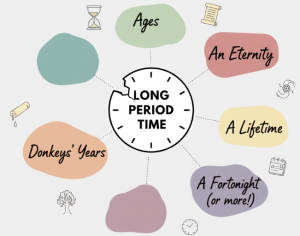
Examples include “ages,” “forever,” “a long while,” “a good stretch,” and “donkey’s years.”
Expressions Indicating Specific Durations
Expressions indicating specific durations provide a more precise timeframe than the general phrase “long period of time.” These phrases use specific units of time, such as years, decades, centuries, or millennia. Examples include “several years,” “many decades,” “a couple of centuries,” and “over a millennium.”
Metaphorical Expressions
Metaphorical expressions use figurative language to convey the concept of extended duration. These phrases often employ imagery and symbolism to create a vivid impression of time passing.
Examples include “an eternity,” “a geological age,” “since the dawn of time,” and “when the dinosaurs roamed the earth.”
Examples
The following sections provide extensive examples of alternative expressions for “long period of time,” organized by category. Each table includes a variety of phrases and example sentences to illustrate their usage.
Formal Expressions Examples
Formal expressions are best suited for professional or academic contexts where clarity and precision are paramount. These phrases avoid colloquialisms and offer a more sophisticated way to convey extended duration.
The following table showcases various formal alternatives along with example sentences.
| Formal Expression | Example Sentence |
|---|---|
| Extended duration | The study examined the effects of the medication over an extended duration. |
| Protracted interval | Negotiations between the two countries continued for a protracted interval. |
| Significant span | The archaeological findings revealed human habitation over a significant span of history. |
| Considerable length of time | The project required a considerable length of time to complete due to its complexity. |
| Lengthy period | The disease remained dormant for a lengthy period before symptoms appeared. |
| Prolonged period | The patient experienced a prolonged period of recovery after the surgery. |
| Substantial duration | The research team observed the behavior of the animals over a substantial duration. |
| Extended timeframe | The company implemented its strategic plan over an extended timeframe. |
| Appreciable time | It took an appreciable time to fully understand the implications of the new policy. |
| Remarkable duration | The monument has stood for a remarkable duration, defying the ravages of time. |
| Sustained interval | The economic boom continued for a sustained interval, benefiting many businesses. |
| Longstanding period | The organization has a longstanding period of commitment to environmental conservation. |
| Considerable timeframe | The development of the city spanned a considerable timeframe. |
| Elongated duration | The experiment involved observing the effects of the drug over an elongated duration. |
| Inordinate amount of time | The bureaucratic process took an inordinate amount of time to complete. |
| Extended lapse of time | An extended lapse of time had passed since their last meeting. |
| Substantial lapse | A substantial lapse occurred before they heard back from the company. |
| Prolonged absence | Her prolonged absence from the office raised concerns among her colleagues. |
| Significant delay | The project experienced a significant delay due to unforeseen circumstances. |
| Lengthy delay | Passengers faced a lengthy delay at the airport because of the storm. |
| Extended wait | Customers had to endure an extended wait to be served at the restaurant. |
| Prolonged period of inactivity | The volcano had a prolonged period of inactivity before its recent eruption. |
| Significant period of dormancy | The seeds remained in a significant period of dormancy until the spring. |
| Extended period of quiescence | The region experienced an extended period of quiescence after the conflict. |
Informal Expressions Examples
Informal expressions are ideal for casual conversations and personal writing. They often employ simpler language and may include colloquialisms.
These phrases provide a more relaxed and relatable way to convey the idea of a long duration. The table below provides a list of informal alternatives with example sentences.
| Informal Expression | Example Sentence |
|---|---|
| Ages | I haven’t seen you in ages! |
| Forever | It feels like I’ve been waiting forever for this moment. |
| A long while | It’s been a long while since we last went to the beach. |
| A good stretch | We drove for a good stretch before stopping for lunch. |
| Donkey’s years | I’ve known him for donkey’s years. |
| An eternity | That meeting felt like an eternity. |
| For the longest time | For the longest time, I thought he was her brother. |
| A coon’s age | It’s been a coon’s age since we last had a proper vacation. |
| A month of Sundays | It will take a month of Sundays to finish this project. |
| A dog’s age | I haven’t eaten pizza in a dog’s age. |
| A lifetime | It felt like a lifetime waiting for the train. |
| For keeps | They thought their troubles were gone for keeps. |
| Until the cows come home | You can practice this until the cows come home, but you still won’t get it right without focusing. |
| In a blue moon | We only see each other in a blue moon. |
| For good | He left the city for good. |
| A long haul | We’re in this for a long haul, so we need to pace ourselves. |
| For quite some time | She lived abroad for quite some time. |
| A spell | He lived there for a spell before moving back home. |
| Since forever | I’ve been a fan of that band since forever. |
| A while back | I saw him a while back at the grocery store. |
| For a stretch | They lived in the countryside for a stretch to escape the city noise. |
| A good innings | He had a good innings and will be remembered fondly. |
| In the long run | In the long run, investing in education is always a good decision. |
| Over time | Over time, the relationship between them grew stronger. |
Specific Durations Examples
When you need to be more precise about the length of time, using expressions that indicate specific durations is helpful. These phrases use concrete units of time to give a clear sense of how long something lasted.
Here are some examples of expressions indicating specific durations along with example sentences.
| Specific Duration Expression | Example Sentence |
|---|---|
| Several years | She worked on the project for several years before it was finally completed. |
| Many decades | The ancient civilization flourished for many decades. |
| A couple of centuries | The castle has stood for a couple of centuries. |
| Over a millennium | The tradition has been passed down for over a millennium. |
| A few weeks | I’ll be on vacation for a few weeks. |
| Several months | The construction project took several months to complete. |
| Numerous years | He dedicated numerous years to researching the subject. |
| A span of decades | The artist’s career covered a span of decades. |
| A period of centuries | The historical event occurred during a period of centuries of upheaval. |
| For countless generations | The legend has been told for countless generations. |
| Over the past few years | Over the past few years, the economy has shown signs of improvement. |
| In recent decades | In recent decades, there has been a growing awareness of environmental issues. |
| Throughout the centuries | Throughout the centuries, art has reflected the changing values of society. |
| For a quarter of a century | He worked at the company for a quarter of a century. |
| Over the course of several months | Over the course of several months, she learned to play the piano. |
| During the last few decades | During the last few decades, technology has transformed the way we live. |
| Within the last century | Within the last century, there have been significant advancements in medicine. |
| In the space of several years | In the space of several years, the small town grew into a bustling city. |
| For a considerable number of years | She studied abroad for a considerable number of years. |
| Over many generations | The family tradition has been passed down over many generations. |
| During a period of several weeks | During a period of several weeks, the students prepared for their final exams. |
| Throughout the duration of several months | Throughout the duration of several months, they monitored the progress of the experiment. |
| For approximately a few years | They lived in Europe for approximately a few years before returning home. |
Metaphorical Expressions Examples
Metaphorical expressions offer a creative and evocative way to describe a long period of time. These phrases use figurative language to paint a vivid picture of duration, often drawing on imagery and symbolism.
The following table provides examples of metaphorical expressions and their usage.
| Metaphorical Expression | Example Sentence |
|---|---|
| An eternity | Waiting for the exam results felt like an eternity. |
| A geological age | It’s been a geological age since we last saw each other. |
| Since the dawn of time | Humans have been fascinated by the stars since the dawn of time. |
| When the dinosaurs roamed the earth | That law is so outdated, it’s like it was written when the dinosaurs roamed the earth. |
| A month of Sundays | It would take a month of Sundays to clean this entire house. |
| A lifetime | That one moment felt like a lifetime. |
| A thousand years | It feels like a thousand years since I last had a good night’s sleep. |
| A cat’s nine lives | It felt like he had a cat’s nine lives after surviving so many close calls. |
| A dog’s age | I haven’t seen that movie in a dog’s age. |
| A coon’s age | It’s been a coon’s age since we last went camping. |
| Since the year dot | She’s been working on that project since the year dot. |
| Ages and ages | It’s been ages and ages since I last wrote a letter. |
| Forever and a day | I’ll love you forever and a day. |
| Since time immemorial | The tradition has been practiced since time immemorial. |
| When the seas were parted | That’s an old story, from back when the seas were parted. |
| Since the hills were young | He’s been telling that joke since the hills were young. |
| A blink of an eye (ironically) | The bureaucracy took a blink of an eye – about six months! |
| A light year away (metaphorically) | The completion of this project seems a light year away. |
| Ancient history | The details of that agreement are ancient history now. |
| A bygone era | The elegance of that time belongs to a bygone era. |
| A page in history | The events of that summer are now just a page in history. |
| A chapter of my life | That time in Paris was an important chapter of my life. |
| A distant memory | The taste of that cake is now just a distant memory. |
Usage Rules
The proper use of alternative expressions for “long period of time” depends on the context, tone, and desired level of formality. Formal expressions are suitable for professional and academic settings, while informal expressions are appropriate for casual conversations.
Specific duration expressions are used when precision is required, and metaphorical expressions are employed for creative and evocative descriptions. It is important to choose the expression that best fits the specific situation and accurately conveys the intended meaning.
Consider the audience and purpose of your communication when selecting an alternative expression. If you are writing a scientific report, a formal expression like “extended duration” or “significant span” would be more appropriate than an informal expression like “ages” or “forever.” Similarly, if you are telling a story to a friend, an informal or metaphorical expression might be more engaging than a formal one.
Pay attention to the connotations of different phrases and choose the one that best reflects the desired tone.
Common Mistakes
One common mistake is using informal expressions in formal contexts, which can make your writing or speech sound unprofessional. For example, using “ages” in a research paper would be inappropriate.
Another mistake is using specific duration expressions inaccurately. For instance, saying “a couple of millennia” when you mean “a few centuries” would be misleading.
Finally, misusing metaphorical expressions can lead to confusion or unintended humor. Ensure that the metaphorical expression you choose is appropriate for the context and that its meaning is clear to your audience.
| Incorrect | Correct | Explanation |
|---|---|---|
| The experiment lasted ages. | The experiment lasted for an extended duration. | “Ages” is informal and unsuitable for a scientific context. |
| The castle is a few millennia old. | The castle is a few centuries old. | “Millennia” implies thousands of years, while “centuries” implies hundreds of years. |
| Waiting for the bus felt like a geological age, so I missed my meeting. | Waiting for the bus felt like an eternity, so I missed my meeting. | While “geological age” conveys a long time, “eternity” is more commonly used in everyday exaggeration of waiting. |
| I’ve known her for donkey’s years in my thesis paper. | I’ve known her for a considerable length of time. | “Donkey’s years” is too informal for academic writing. |
| The project took a month of Sundays in the board meeting. | The project took a considerable amount of time. | “A month of Sundays” is too colloquial for a professional setting. |
Practice Exercises
Test your understanding of alternative expressions for “long period of time” with the following exercises. Choose the most appropriate expression from the options provided to complete each sentence.
Exercise 1: Choose the correct formal expression.
| Question | Options | Answer |
|---|---|---|
| The study tracked the patients’ progress over an _____. | a) ages, b) extended duration, c) forever | b) extended duration |
| Negotiations between the two countries continued for a _____ without any resolution. | a) protracted interval, b) a while, c) donkey’s years | a) protracted interval |
| The archaeological site revealed human habitation over a _____ of history. | a) significant span, b) a good stretch, c) a long haul | a) significant span |
| The project required a _____ to complete due to its complexity. | a) considerable length of time, b) ages, c) a blink of an eye | a) considerable length of time |
| The disease remained dormant for a _____ before symptoms began to appear. | a) lengthy period, b) a month of Sundays, c) forever | a) lengthy period |
| The experiment ran for a _____, collecting data points every hour. | a) prolonged period, b) a while back, c) a dog’s age | a) prolonged period |
| The research team observed the animals’ behavior for a _____. | a) substantial duration, b) ages, c) a blue moon | a) substantial duration |
| The company implemented its strategic plan over an _____. | a) extended timeframe, b) forever, c) a coon’s age | a) extended timeframe |
| It took an _____ to fully understand the implications of the new policy. | a) appreciable time, b) a while, c) donkey’s years | a) appreciable time |
| The monument has stood for a _____, defying the ravages of time. | a) remarkable duration, b) ages, c) forever | a) remarkable duration |
Exercise 2: Choose the correct informal expression.
| Question | Options | Answer |
|---|---|---|
| I haven’t seen you in _____. What have you been up to? | a) ages, b) extended duration, c) significant span | a) ages |
| It feels like I’ve been waiting _____ for this package to arrive. | a) forever, b) protracted interval, c) considerable length of time | a) forever |
| It’s been _____ since we last went camping. We should plan a trip soon. | a) a long while, b) substantial duration, c) remarkable duration | a) a long while |
| We drove for _____ before stopping to get gas. | a) a good stretch, b) appreciable time, c) elongated duration | a) a good stretch |
| I’ve known him for _____. We went to elementary school together. | a) donkey’s years, b) extended timeframe, c) prolonged period | a) donkey’s years |
| That meeting felt like _____. I thought it would never end. | a) an eternity, b) prolonged period, c) substantial lapse | a) an eternity |
| _____, I thought he was her brother. | a) for the longest time, b) remarkable duration, c) significant delay | a) for the longest time |
| It’s been _____ since we’ve had a proper vacation. | a) a coon’s age, b) significant period of dormancy, c) prolonged absence | a) a coon’s age |
| It will take _____ to finish this project. | a) a month of Sundays, b) sustained interval, c) lengthy delay | a) a month of Sundays |
| I haven’t eaten pizza in _____. | a) a dog’s age, b) extended wait, c) lengthy period | a) a dog’s age |
Exercise 3: Rewrite the sentences using a more appropriate expression for “long period of time”
| Original Sentence | Rewritten Sentence |
|---|---|
| I waited a long period of time for the bus. | I waited ages for the bus. |
| The company has been in business for a long period of time. | The company has been in business for several decades. |
| It feels like a long period of time since I last saw you. | It feels like an eternity since I last saw you. |
| The project took a long period of time to complete. | The project took a considerable length of time to complete. |
| She studied abroad for a long period of time. | She studied abroad for numerous years. |
| The tradition has been passed down for a long period of time. | The tradition has been passed down for countless generations. |
| The negotiations lasted a long period of time. | The negotiations continued for a protracted interval. |
| It’s been a long period of time since we went on vacation. | It’s been a coon’s age since we went on vacation. |
| Waiting for the train felt like a long period of time. | Waiting for the train felt like a lifetime. |
| The experiment ran for a long period of time. | The experiment ran for a prolonged period. |
Advanced Topics
For advanced learners, exploring the nuances of temporal adverbs and adverbial phrases can further enhance their understanding of expressing duration. This includes studying the subtle differences between synonyms, understanding the impact of word choice on tone and style, and analyzing how different expressions are used in various genres of writing.
Additionally, delving into the historical evolution of these expressions can provide a deeper appreciation for the richness and complexity of the English language.
Another advanced topic is the use of clauses and complex sentence structures to express extended duration. For example, instead of saying “The project took a long time,” you could say “The project took longer than anticipated due to unforeseen circumstances.” This type of sentence structure provides more detail and adds depth to your writing.
Mastering these advanced techniques will enable you to express the concept of “long period of time” with greater sophistication and precision.
FAQ
Here are some frequently asked questions about alternative expressions for “long period of time.”
- What is the difference between “extended duration” and “prolonged period”?
“Extended duration” typically refers to the length of an event or activity, while “prolonged period” often implies a state or condition that lasts for a considerable time. Both are formal and interchangeable in many contexts, but “prolonged” can sometimes suggest something undesirable, like “prolonged suffering.”
- When should I use a specific duration expression instead of a general one?
Use a specific duration expression when you need to provide precise information about the length of time. This is particularly important in scientific, technical, and historical contexts where accuracy is crucial. For example, instead of saying “The experiment lasted a long time,” say “The experiment lasted for three weeks.”
- How can I avoid sounding repetitive when using alternative expressions for “long period of time”?
Vary your vocabulary by using a mix of formal, informal, specific, and metaphorical expressions. Pay attention to the context and choose the expression that best fits the situation. Also, try using different sentence structures and clauses to add variety to your writing.
- Are there any expressions that should be avoided in formal writing?
Yes, avoid informal expressions, colloquialisms, and slang in formal writing. Stick to formal expressions like “extended duration,” “protracted interval,” and “significant span.” Also, be cautious with metaphorical expressions, as they can sometimes be misinterpreted or seen as inappropriate in certain contexts.
- Can the meaning of “a long period of time” change depending on the context?
Yes, the perception of what constitutes a “long period of time” is subjective and depends heavily on the context. For example, waiting five minutes for a bus might feel like a long time, while five years might seem like a short time in the context of historical events.
- Is it ever appropriate to use “long period of time” itself?
Yes, “long period of time” is a perfectly acceptable phrase in many contexts, especially when you don’t need to be overly specific or formal. However, diversifying your vocabulary with alternative expressions can make your writing and speech more engaging and sophisticated.
- How do I know which expression is most appropriate for a given situation?
Consider the audience, purpose, and tone of your communication. If you’re writing a formal report for a professional audience, stick to formal expressions. If you’re chatting with friends, informal expressions are fine. If you need to be precise, use specific duration expressions. And if you want to add a touch of creativity and imagery, use metaphorical expressions.
- Are there any regional differences in the use of these expressions?
Yes, some expressions may be more common in certain regions or dialects of English. For example, “a coon’s age” is more common in American English, while “donkey’s years” is more common in British English. Be aware of these regional differences and choose expressions that are appropriate for your audience.
Conclusion
Mastering alternative expressions for “long period of time” is a valuable skill that can significantly enhance your English communication. By understanding the different categories of expressions – formal, informal, specific, and metaphorical – and practicing their usage, you can convey the concept of extended duration with greater precision, nuance, and style.
Remember to consider the context, audience, and purpose of your communication when choosing an expression, and avoid common mistakes by using appropriate language for the situation.
As you continue to develop your English skills, pay attention to how native speakers use these expressions in various contexts. Read widely, listen attentively, and practice regularly to internalize these phrases and make
them a natural part of your vocabulary.
With consistent effort, you’ll be able to express the idea of a “long period of time” with confidence and fluency, adding depth and richness to your communication.