

Understanding the nuances of language involves not just knowing what words mean, but also grasping their opposites. “Misery,” a powerful descriptor of deep suffering and unhappiness, has a rich array of antonyms that paint vivid pictures of joy, contentment, and well-being.
Exploring these antonyms enhances our vocabulary, improves our ability to express a wider range of emotions, and deepens our appreciation for the complexities of the human experience. This article delves into the diverse and delightful world of words that stand in stark contrast to “misery,” providing definitions, examples, and practical exercises to help you master their usage.
Whether you’re a student, writer, or simply a language enthusiast, this comprehensive guide will equip you with the tools to articulate happiness and its many forms with precision and flair.
By mastering antonyms of misery, you can enrich your vocabulary, express emotions more vividly, and gain a deeper understanding of the human experience. This article is designed for English language learners, writers, and anyone looking to expand their linguistic toolkit.
Table of Contents
- Introduction
- Definition of “Misery” and Its Antonyms
- Structural Breakdown of Antonyms
- Types and Categories of Antonyms of Misery
- Examples of Antonyms of Misery
- Usage Rules for Antonyms of Misery
- Common Mistakes When Using Antonyms of Misery
- Practice Exercises
- Advanced Topics
- Frequently Asked Questions
- Conclusion
Definition of “Misery” and Its Antonyms
Misery is a state of great unhappiness or suffering. It encompasses physical, emotional, and mental distress, often characterized by feelings of sadness, despair, and hopelessness. It is a profound and pervasive sense of negativity that can significantly impact a person’s well-being and quality of life.
Antonyms of misery represent the opposite end of the emotional spectrum. They describe states of well-being, joy, and contentment.
These words are crucial for expressing positive emotions and experiences, providing a counterpoint to the darker aspects of human existence. Understanding these antonyms allows us to articulate a broader range of feelings and appreciate the nuances of happiness and fulfillment.
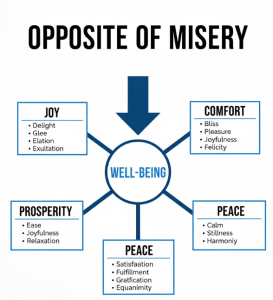
Structural Breakdown of Antonyms
Antonyms, in general, are words that have opposite meanings. The antonyms of “misery” often function as nouns, adjectives, or adverbs, depending on the context.
As nouns, they represent states of being (e.g., happiness, joy). As adjectives, they describe qualities or characteristics (e.g., happy, joyful).
As adverbs, they modify verbs, adjectives, or other adverbs to indicate the manner in which something is done (e.g., happily, joyfully).
Structurally, many antonyms are formed through prefixes such as “un-“, “in-“, “dis-“, or “a-“. However, the antonyms of “misery” are typically unrelated words that have evolved to represent contrasting concepts.
They are not simply negations of “misery” but rather distinct terms with their own rich histories and connotations. For example, “happiness” is not formed by adding a prefix to “misery”; it is a completely separate word with its own etymological roots and cultural associations.
Types and Categories of Antonyms of Misery
The antonyms of “misery” can be categorized based on the specific aspect of well-being they emphasize. Here are some key categories:
Happiness and Joy
Happiness is a general state of well-being characterized by positive emotions ranging from contentment to intense joy. It is often associated with satisfaction, pleasure, and a sense of fulfillment. Joy is a more intense and exuberant form of happiness, often triggered by specific events or experiences. It is characterized by feelings of elation, delight, and excitement. While happiness can be a sustained state, joy is often more fleeting and intense.
Contentment and Satisfaction
Contentment is a state of peaceful happiness and satisfaction. It implies a sense of ease and acceptance, often arising from appreciating what one has rather than striving for more. Satisfaction is a feeling of pleasure or fulfillment that comes from achieving a goal, fulfilling a need, or experiencing something enjoyable. It is often more specific and goal-oriented than contentment, which is a more general state of being.
Pleasure and Delight
Pleasure is a feeling of enjoyment or satisfaction. It can be derived from a variety of sources, including sensory experiences, social interactions, and intellectual pursuits. Delight is a feeling of great pleasure and joy. It is often associated with surprise, wonder, and a sense of childlike excitement. Delight is a more intense and unexpected form of pleasure.
Cheerfulness and Optimism
Cheerfulness is a state of being noticeably happy and optimistic. It involves a positive attitude, a bright outlook, and a tendency to see the good in things. Optimism is a belief that good things will happen in the future. It is a mindset that focuses on the positive aspects of situations and anticipates favorable outcomes. Cheerfulness is often an outward expression of optimism.
Peace and Tranquility
Peace is a state of calmness and serenity, free from disturbance or conflict. It can refer to inner peace, social harmony, or the absence of war. Tranquility is a state of quietness and peacefulness. It implies a sense of stillness and serenity, often associated with nature and relaxation. Tranquility is a more specific and sensory experience of peace.
Bliss and Ecstasy
Bliss is a state of perfect happiness and joy. It is often associated with spiritual enlightenment, profound love, or a sense of complete fulfillment. Ecstasy is an overwhelming feeling of great happiness or joyful excitement. It is often a temporary and intense state, characterized by a sense of being transported beyond oneself. Both are intense and profound states of happiness, with ecstasy often implying a more transient and overwhelming experience.
Examples of Antonyms of Misery
The following tables provide examples of how these antonyms can be used in sentences, illustrating their different nuances and contexts.
Examples with “Happiness”
The following table provides 30 examples of using the word “Happiness” in different contexts.
| Sentence |
|---|
| Her happiness was evident in her radiant smile. |
| They found happiness in simple pleasures. |
| The children’s laughter filled the house with happiness. |
| He sought happiness through meditation and mindfulness. |
| Happiness is a journey, not a destination. |
| She defined happiness as having good health and loving relationships. |
| The secret to happiness is gratitude. |
| Their wedding day was filled with immense happiness. |
| He radiated happiness after receiving the good news. |
| She discovered happiness in helping others. |
| The warmth of the sun brought a feeling of happiness. |
| He found happiness in his work and his family. |
| Happiness is often found in unexpected places. |
| The vibrant colors of the garden brought her happiness. |
| He realized that happiness comes from within. |
| She equated happiness with freedom and independence. |
| Their reunion was a moment of pure happiness. |
| He believed that happiness is contagious. |
| The birth of their child brought them unparalleled happiness. |
| She chased happiness but realized it was already within her reach. |
| The sound of music filled the room with happiness. |
| He measured his success by his level of happiness. |
| She found happiness in the beauty of nature. |
| Their shared laughter was a testament to their happiness. |
| He learned that happiness is a choice. |
| She spread happiness wherever she went. |
| The aroma of freshly baked bread evoked feelings of happiness. |
| He discovered that happiness is often found in the little things. |
| She cultivated happiness through positive affirmations. |
| Their love story was a source of happiness for everyone around them. |
Examples with “Contentment”
The following table provides 30 examples of using the word “Contentment” in different contexts.
| Sentence |
|---|
| She found contentment in her simple life. |
| He felt a deep sense of contentment after finishing the project. |
| Contentment is often found in appreciating what you have. |
| She radiated contentment as she sat by the fire. |
| He sought contentment through mindfulness and meditation. |
| Contentment is not about having everything, but appreciating everything you have. |
| She defined contentment as inner peace and acceptance. |
| He realized that contentment is a key to happiness. |
| She cultivated contentment by focusing on the present moment. |
| He felt a surge of contentment after a long day’s work. |
| She found contentment in her garden, surrounded by nature. |
| He learned that contentment is a state of mind. |
| She discovered contentment in helping others. |
| He sought contentment not in material possessions, but in experiences. |
| She found contentment in the quiet moments of her day. |
| He realized that contentment is a choice. |
| She cultivated contentment by practicing gratitude. |
| He felt a deep sense of contentment with his life. |
| She found contentment in the love of her family. |
| He sought contentment by living a simple and meaningful life. |
| She realized that contentment is more valuable than wealth. |
| He cultivated contentment by focusing on his blessings. |
| She found contentment in the beauty of the world around her. |
| He sought contentment by pursuing his passions. |
| She realized that contentment is a journey, not a destination. |
| He cultivated contentment by accepting what he cannot change. |
| She found contentment in the companionship of her friends. |
| He sought contentment by living in harmony with nature. |
| She realized that contentment is the key to a fulfilling life. |
| He cultivated contentment by appreciating the small things. |
Examples with “Pleasure”
The following table provides 30 examples of using the word “Pleasure” in different contexts.
| Sentence |
|---|
| She took great pleasure in painting landscapes. |
| He found pleasure in reading a good book. |
| The concert was a pleasure to attend. |
| She derived pleasure from helping others. |
| It was a pleasure meeting you. |
| He found pleasure in the simple things in life. |
| She experienced pleasure in the warmth of the sun. |
| He took pleasure in watching the sunset. |
| She found pleasure in the company of her friends. |
| He derived pleasure from his work. |
| She found pleasure in cooking for her family. |
| He took pleasure in playing music. |
| She found pleasure in the beauty of nature. |
| He derived pleasure from traveling to new places. |
| She found pleasure in learning new things. |
| He took pleasure in spending time with his family. |
| She found pleasure in the quiet moments of her day. |
| He derived pleasure from exercising. |
| She found pleasure in the taste of good food. |
| He took pleasure in the challenge of solving puzzles. |
| She found pleasure in the laughter of children. |
| He derived pleasure from the success of his students. |
| She found pleasure in the comfort of her home. |
| He took pleasure in the beauty of art. |
| She found pleasure in the fragrance of flowers. |
| He derived pleasure from the satisfaction of a job well done. |
| She found pleasure in the rhythm of dance. |
| He took pleasure in the thrill of adventure. |
| She found pleasure in the simplicity of nature. |
| He derived pleasure from the power of knowledge. |
Examples with “Cheerfulness”
The following table provides 30 examples of using the word “Cheerfulness” in different contexts.
| Sentence |
|---|
| Her cheerfulness was infectious, brightening everyone’s day. |
| Despite the challenges, he maintained his cheerfulness. |
| The room was filled with cheerfulness and laughter. |
| Her cheerfulness was a welcome contrast to the gloomy weather. |
| He approached every task with cheerfulness and enthusiasm. |
| Her cheerfulness brought a smile to his face. |
| The atmosphere was filled with cheerfulness and goodwill. |
| He was known for his unwavering cheerfulness. |
| Her cheerfulness was a source of inspiration to others. |
| Despite the setback, she maintained her cheerfulness. |
| The party was filled with cheerfulness and celebration. |
| His cheerfulness was a constant reminder to stay positive. |
| Her cheerfulness was like a ray of sunshine. |
| He greeted everyone with cheerfulness and warmth. |
| The event was marked by cheerfulness and camaraderie. |
| Her cheerfulness was a gift to those around her. |
| He faced adversity with cheerfulness and determination. |
| The atmosphere was charged with cheerfulness and excitement. |
| Her cheerfulness was a beacon of hope. |
| He spread cheerfulness wherever he went. |
| The room radiated with cheerfulness during the holiday season. |
| His cheerfulness was a testament to his resilience. |
| Her cheerfulness was a reflection of her inner peace. |
| He met challenges with unwavering cheerfulness and optimism. |
| The community celebrated with cheerfulness and unity. |
| Her cheerfulness was an inspiration to overcome obstacles. |
| He approached life with a contagious sense of cheerfulness. |
| The gathering was filled with cheerfulness and laughter. |
| Her cheerfulness was a source of comfort to those in need. |
| He faced each day with renewed cheerfulness and purpose. |
Examples with “Peace”
The following table provides 30 examples of using the word “Peace” in different contexts.
| Sentence |
|---|
| She found peace in the quiet solitude of the forest. |
| He longed for peace after years of conflict. |
| The treaty brought peace to the war-torn region. |
| She sought inner peace through meditation. |
| The dove is a symbol of peace. |
| He found peace in his faith. |
| She cherished the peace and quiet of her home. |
| He worked tirelessly to promote peace and understanding. |
| She found peace in the beauty of nature. |
| He sought peace of mind through self-reflection. |
| The community worked together to maintain peace and harmony. |
| She found peace in forgiveness. |
| He longed for a world filled with peace and justice. |
| She found peace in the love of her family. |
| He sought peace through acts of kindness. |
| The garden offered a sanctuary of peace and tranquility. |
| She found peace in acceptance. |
| He worked to build bridges of peace between cultures. |
| She found peace in the rhythm of the ocean. |
| He sought peace through creative expression. |
| The retreat offered a space for inner peace and reflection. |
| She found peace in gratitude. |
| He worked to create a lasting legacy of peace. |
| She found peace in the simplicity of life. |
| He sought peace through compassionate action. |
| The mountains offered a sense of peace and serenity. |
| She found peace in letting go. |
| He strived to live a life of peace and integrity. |
| The sanctuary provided a haven of peace for all. |
| She found peace in the present moment. |
Examples with “Bliss”
The following table provides 30 examples of using the word “Bliss” in different contexts.
| Sentence |
|---|
| She experienced a moment of pure bliss as she watched the sunrise. |
| He found bliss in the arms of his loved one. |
| The concert transported the audience to a state of musical bliss. |
| She felt a sense of bliss during her spiritual retreat. |
| The couple was lost in marital bliss. |
| He found bliss in the simple act of meditation. |
| She experienced bliss while dancing under the stars. |
| He discovered bliss in helping others. |
| She found bliss in the beauty of a blooming flower. |
| He experienced bliss while listening to his favorite music. |
| She found bliss in the warmth of a summer day. |
| He discovered bliss in the laughter of children. |
| She experienced bliss during her travels. |
| He found bliss in the pursuit of knowledge. |
| She felt a moment of bliss as she reached her goals. |
| He discovered bliss in nature. |
| She experienced bliss in the comfort of her home. |
| He found bliss in his creative endeavors. |
| She felt bliss as she held her newborn child. |
| He discovered bliss in the act of forgiveness. |
| She experienced bliss while volunteering at the local shelter. |
| He found bliss in the companionship of his friends. |
| She felt bliss during her yoga practice. |
| He discovered bliss in the act of self-discovery. |
| She experienced bliss while watching a breathtaking sunset. |
| He found bliss in the act of selfless service. |
| She felt bliss as she connected with her inner self. |
| He discovered bliss in the power of love. |
| She experienced bliss during her meditation session. |
| He found bliss in the simple act of breathing. |
Usage Rules for Antonyms of Misery
Using antonyms of “misery” correctly involves understanding their specific connotations and the contexts in which they are most appropriate. Here are some key usage rules:
- Choose the right intensity: Select the antonym that best matches the degree of happiness or well-being you want to convey. “Happiness” is a general term, while “bliss” and “ecstasy” are more intense. “Contentment” is more subdued than “joy.”
- Consider the cause: The source of the positive emotion can influence your choice of antonym. “Pleasure” might be used for sensory experiences, while “satisfaction” is more appropriate for achieving a goal.
- Pay attention to tone: Some antonyms have a more formal or literary tone than others. “Tranquility” and “ecstasy” might be more suitable for formal writing, while “happiness” and “joy” are appropriate in most contexts.
- Avoid clichés: While these words are common, try to use them in fresh and original ways to avoid sounding repetitive or uninspired. Use descriptive language to enhance the impact of your writing.
Common Mistakes When Using Antonyms of Misery
Here are some common mistakes to avoid when using antonyms of “misery”:
| Incorrect | Correct | Explanation |
|---|---|---|
| She felt misery after winning the lottery. | She felt happiness after winning the lottery. | “Misery” is the opposite of what she would feel after a positive event like winning the lottery. |
| He was filled with sadness at the birth of his child. | He was filled with joy at the birth of his child. | “Sadness” is inappropriate for the birth of a child, which is typically a joyous occasion. |
| The funeral was a time of great pleasure. | The funeral was a time of great sorrow. | “Pleasure” is inappropriate for a funeral, which is a time of mourning. |
| She experienced tranquility during the loud concert. | She experienced excitement during the loud concert. | “Tranquility” implies calmness, which is the opposite of what one would feel at a loud concert. |
| He felt misery after achieving his lifelong goal. | He felt satisfaction after achieving his lifelong goal. | “Misery” is the opposite of what he would feel after achieving a goal. |
| She was content with her constant state of anxiety. | She was at peace despite her anxiety. | “Content” suggests a state of happiness, which is contradictory to feeling anxiety. |
Practice Exercises
Test your understanding of the antonyms of “misery” with these exercises.
- Exercise 1: Fill in the BlanksComplete the following sentences with the most appropriate antonym of “misery” from the list: happiness, contentment, pleasure, cheerfulness, peace, bliss.
Question Answer 1. She found ______ in the simple act of gardening. contentment 2. The birth of their child brought them immense ______. happiness 3. He experienced a moment of pure ______ as he listened to his favorite music. bliss 4. Her ______ was contagious, brightening everyone’s day. cheerfulness 5. She sought ______ in the quiet solitude of the forest. peace 6. He derived great ______ from helping those in need. pleasure 7. After a long day’s work, she felt a sense of ______. contentment 8. The wedding was filled with ______ and celebration. happiness 9. He found ______ in the beauty of the natural world. bliss 10. Her ______ was a welcome contrast to the gloomy weather. cheerfulness - Exercise 2: Sentence TransformationRewrite the following sentences, replacing the word “misery” or its synonyms with an appropriate antonym.
Question Answer 1. He felt great despair after losing his job. He felt great disappointment after losing his job. 2. Her life was filled with sorrow and suffering. Her life was filled with joy and happiness. 3. The constant pain brought him nothing but anguish. The constant support brought him nothing but comfort. 4. She was consumed by grief after the loss of her loved one. She was filled with fond memories after the loss of her loved one. 5. The war brought widespread devastation and wretchedness. The peace brought widespread restoration and prosperity. 6. His heart was heavy with sadness and gloom. His heart was light with happiness and hope. 7. The failure of the project caused him deep distress. The success of the project brought him deep satisfaction. 8. She was overwhelmed by feelings of hopelessness and despair. She was filled with feelings of hope and optimism. 9. The tragic accident left him in a state of profound grief. The fortunate recovery left him in a state of profound relief. 10. He was plagued by constant worry and anxiety. He was blessed by constant peace and tranquility. - Exercise 3: Word AssociationMatch each word in the left column with its closest antonym from the right column.
Word Antonym 1. Sorrow a. Cheerfulness 2. Despair b. Contentment 3. Anguish c. Bliss 4. Gloom d. Peace 5. Wretchedness e. Joy 6. Anxiety f. Pleasure 7. Suffering g. Happiness 8. Distress h. Hope 9. Grief i. Relief 10. Melancholy j. Well-being Answers: 1-e, 2-h, 3-i, 4-a, 5-j, 6-d, 7-f, 8-b, 9-g, 10-
c
Advanced Topics
For those looking to delve deeper into the subject, here are some advanced topics to explore:
- The Psychology of Happiness: Investigate the psychological factors that contribute to happiness and well-being, such as positive emotions, engagement, relationships, meaning, and achievement (PERMA).
- The Philosophy of Happiness: Explore philosophical perspectives on happiness, from ancient Greek philosophers to modern thinkers, and consider different theories of what constitutes a good life.
- Cross-Cultural Perspectives on Happiness: Examine how different cultures define and pursue happiness, and consider the role of cultural values and beliefs in shaping emotional experiences.
- The Relationship Between Language and Emotion: Investigate how language influences our understanding and expression of emotions, and consider how different languages might shape our experiences of happiness and misery.
Frequently Asked Questions
What is the difference between happiness and joy?
Happiness is a general state of well-being, while joy is a more intense and exuberant emotion often triggered by specific events or experiences.
How can I cultivate more contentment in my life?
Practice gratitude, focus on the present moment, and appreciate what you have rather than striving for more.
What are some synonyms for “misery”?
Sorrow, despair, anguish, suffering, grief, wretchedness, and distress are all synonyms for “misery.”
Is it possible to be happy all the time?
While striving for happiness is a worthwhile goal, it’s important to acknowledge that life inevitably involves a range of emotions, including sadness and disappointment. Aim for overall well-being and resilience rather than constant, unwavering happiness.
How can I help someone who is experiencing misery?
Offer support, empathy, and understanding. Encourage them to seek professional help if needed, and remind them that they are not alone.
Conclusion
Exploring the antonyms of “misery” not only enriches our vocabulary but also deepens our understanding of human emotions and experiences. By mastering these words and their nuances, we can express ourselves more effectively, appreciate the positive aspects of life, and cultivate greater well-being.
Whether you’re a writer, a student, or simply a language enthusiast, the journey through the joyful lexicon of antonyms is a rewarding one.