

Describing something as simple as a watermelon can be surprisingly nuanced. The English language offers a rich variety of adjectives to capture the fruit’s diverse characteristics – from its appearance and taste to its texture and origin.
Understanding and using these adjectives correctly not only enhances your vocabulary but also improves your ability to communicate vividly and precisely. This article provides a comprehensive guide to adjectives for watermelon, exploring their meanings, usage, and common pitfalls.
It is designed for English language learners of all levels, from beginners to advanced speakers, as well as anyone who wants to refine their descriptive skills.
Whether you’re writing a poem, crafting a menu description, or simply chatting with friends, mastering these adjectives will help you express yourself with greater clarity and confidence. Dive in to discover the descriptive power of language when it comes to this refreshing summer fruit!
Table of Contents
- What is an Adjective?
- Structural Breakdown of Adjectives
- Types of Adjectives
- Adjectives to Describe Watermelon
- Examples of Adjectives Used with Watermelon
- Usage Rules for Adjectives
- Common Mistakes with Adjectives
- Practice Exercises
- Advanced Topics: Figurative Language
- Frequently Asked Questions
- Conclusion
What is an Adjective?
An adjective is a word that modifies a noun or pronoun. Its primary function is to describe or provide more information about the noun it modifies.
Adjectives add detail, color, and specificity to our language, making it more expressive and engaging. They answer questions like “What kind?”, “Which one?”, “How many?”, and “How much?” about the noun they are describing.
For example, in the phrase “a red watermelon,” the word “red” is an adjective. It describes the color of the watermelon, giving us more information about it. Without the adjective “red,” we would only know that it is a watermelon, but not its color. Adjectives are therefore essential for creating vivid and detailed descriptions.
Adjectives can appear before the noun they modify (attributive position) or after a linking verb (predicative position). Understanding the different types and positions of adjectives is crucial for effective communication.
Structural Breakdown of Adjectives
Adjectives, while seemingly simple, have structural nuances that affect their placement and usage within a sentence. Understanding these nuances can significantly improve your grammatical accuracy and writing style.
Attributive Adjectives: These adjectives appear directly before the noun they modify. They are the most common type of adjective and are typically single words, such as “sweet,” “large,” or “green.” Example: “The sweet watermelon was refreshing.”
Predicative Adjectives: These adjectives follow a linking verb (such as is, are, was, were, seems, appears, becomes) and describe the subject of the sentence. Example: “The watermelon is ripe.” In this case, “ripe” describes the state of the watermelon.
Compound Adjectives: These adjectives are formed by combining two or more words, often hyphenated. Example: “The seedless watermelon is easy to eat.” Another example: “The watermelon was mouth-watering.”
Order of Adjectives: When using multiple adjectives before a noun, there is a general order to follow: opinion, size, age, shape, color, origin, material, and purpose. For example: “a delicious large ripe green local watermelon.” While this order is not always strictly followed, it provides a helpful guideline for constructing grammatically sound and natural-sounding sentences.
Types of Adjectives
Adjectives are broadly categorized based on their function and the type of information they convey. Recognizing these categories can help you choose the most appropriate adjective for a given context.
Descriptive Adjectives
These adjectives describe the qualities or characteristics of a noun. They answer the question “What kind?” Examples include: “sweet,” “juicy,” “red,” “large,” “delicious,” and “refreshing.” These are most commonly used for describing food like watermelon.
Quantitative Adjectives
These adjectives indicate the quantity or amount of the noun. Examples include: “whole,” “half,” “many,” “few,” “some,” and “enough.” For example, “I ate a whole watermelon,” or “We bought several watermelons.”
Demonstrative Adjectives
These adjectives point out specific nouns. They include “this,” “that,” “these,” and “those.” Examples: “This watermelon is the best I’ve ever tasted,” or “Those watermelons are from my garden.”
Possessive Adjectives
These adjectives show ownership or possession. They include “my,” “your,” “his,” “her,” “its,” “our,” and “their.” Example: “My watermelon patch is producing a lot this year.”
Interrogative Adjectives
These adjectives are used to ask questions about nouns. They include “which,” “what,” and “whose.” Example: “Which watermelon do you want to buy?”
Proper Adjectives
These adjectives are formed from proper nouns and usually modify other nouns. Example: “Florida watermelon” (watermelon grown in Florida).
Adjectives to Describe Watermelon
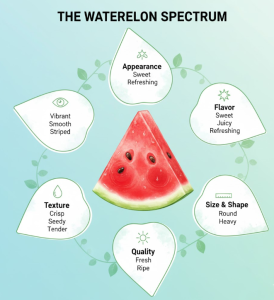
Describing a watermelon involves considering its various attributes. Here’s a breakdown of adjectives categorized by the aspect of the watermelon they describe.
Adjectives Describing Appearance
These adjectives describe the visual characteristics of the watermelon, such as its color, shape, and overall appearance.
- Green: Describing the typical color of the outer rind.
- Striped: Indicating the pattern on the rind.
- Round: Describing the shape of the watermelon.
- Oval: Another possible shape of the watermelon.
- Dark: Referring to a darker shade of green on the rind.
- Light: Referring to a lighter shade of green on the rind.
- Shiny: Describing the reflective quality of the rind.
- Dull: Describing a non-reflective rind.
- Speckled: Having small spots or marks.
- Yellow (flesh): Describing the color of the flesh inside.
- Pink (flesh): Describing the color of the flesh inside.
- Red (flesh): Describing the color of the flesh inside.
- Pale: Describing a light or faded color.
- Watery: Suggesting a high water content, often visually apparent.
- Unblemished: Describing a rind without any marks or imperfections.
- Perfect: Describing an ideal appearance.
- Large: Indicating a significant size.
- Small: Indicating a diminutive size.
- Heavy: Describing the weight of the watermelon.
- Giant: Describing an exceptionally large watermelon.
Adjectives Describing Taste
These adjectives describe the flavor of the watermelon, which is crucial for conveying its appeal.
- Sweet: The most common descriptor for watermelon flavor.
- Juicy: Describing the abundance of liquid.
- Refreshing: Conveying a cooling and invigorating quality.
- Delicious: A general term for a pleasing taste.
- Flavorful: Full of flavor.
- Sugary: Excessively sweet.
- Mild: A subtle or delicate flavor.
- Tangy: Having a slightly acidic or tart taste.
- Bland: Lacking flavor.
- Watery (taste): Tasting diluted or lacking intensity.
- Honeyed: Resembling the taste of honey.
- Ripe: Indicating the watermelon is ready to eat and at its best flavor.
- Overripe: Indicating the watermelon is past its prime and may be too soft.
- Tart: Sharp or sour taste.
- Crisp: A fresh, clean taste.
- Fruity: Having a characteristic fruit flavor.
- Exotic: An unusual or distinct flavor.
- Mouth-watering: Causing salivation due to its appealing taste.
- Luscious: Rich and intensely flavorful.
- Wonderful: A very pleasing taste.
Adjectives Describing Texture
These adjectives describe how the watermelon feels in your mouth, adding another dimension to the description.
- Crisp: Firm and slightly resistant to biting.
- Juicy: Full of liquid.
- Soft: Easily yielding to pressure.
- Firm: Solid and resistant to pressure.
- Grainy: Having a slightly rough or gritty texture.
- Smooth: Having an even and consistent texture.
- Gritty: Containing small, hard particles.
- Mushy: Soft and pulpy, often indicating over ripeness.
- Tender: Easy to chew.
- Fibrous: Containing strands or fibers.
- Succulent: Full of juice and flavor.
- Watery (texture): Feeling excessively wet.
- Pulpy: Containing soft, fleshy parts.
- Dense: Having a compact texture.
- Light: Having a delicate texture.
- Refreshing: A cool, clean texture.
- Velvety: Smooth and soft like velvet.
- Silky: Smooth and fine in texture.
- Coarse: Rough and uneven texture.
- Fine: Delicate and smooth texture.
Adjectives Describing Size
These adjectives provide information about the physical dimensions of the watermelon.
- Large: Above average in size.
- Small: Below average in size.
- Huge: Extremely large.
- Tiny: Very small.
- Giant: Exceptionally large.
- Miniature: Very small, often a cultivated variety.
- Big: Large.
- Petite: Small and delicate.
- Enormous: Extremely large.
- Weighty: Heavy.
- Lightweight: Not heavy.
- Bulky: Large and unwieldy.
- Compact: Small and tightly packed.
- Substantial: Of considerable size.
- Average-sized: Of typical size.
- Oversized: Larger than normal.
- Undersized: Smaller than normal.
- Long: Having considerable length.
- Short: Having little length.
- Wide: Having considerable width.
Adjectives Describing Origin
These adjectives indicate where the watermelon comes from, often implying certain characteristics associated with that region.
- Local: Grown in the immediate area.
- Imported: Brought in from another country.
- Organic: Grown without synthetic pesticides or fertilizers.
- Farm-fresh: Recently harvested from a farm.
- Homegrown: Grown in someone’s personal garden.
- Wild: Growing naturally without cultivation.
- Regional: Specific to a particular region or area.
- California: Grown in California.
- Texas: Grown in Texas.
- Florida: Grown in Florida.
- Georgia: Grown in Georgia.
- Mexican: Grown in Mexico.
- Japanese: Grown in Japan.
- Heirloom: Grown from seeds passed down through generations.
- Cultivated: Grown under controlled conditions.
- Greenhouse-grown: Grown in a greenhouse.
- Naturally-grown: Grown using natural methods.
- Sustainably-grown: Grown using sustainable practices.
- Fair-trade: Produced under fair labor conditions.
- Artisanal: Produced with traditional methods and high quality.
Adjectives Describing Quality
These adjectives express an overall assessment of the watermelon, reflecting its desirability and condition.
- Delicious: Highly pleasing to the taste.
- Excellent: Of very high quality.
- Good: Of acceptable quality.
- Perfect: Flawless and ideal.
- Ripe: Ready to be eaten.
- Unripe: Not yet ready to be eaten.
- Fresh: Recently harvested and in good condition.
- High-quality: Of superior standard.
- Premium: Of the highest quality.
- Choice: Selected for its superior quality.
- Fine: Of excellent quality.
- Superior: Better than average.
- Wonderful: Inspiring delight.
- Exceptional: Unusual and outstanding.
- Remarkable: Worthy of attention.
- Outstanding: Exceptionally good.
- Satisfactory: Meeting expectations.
- Mediocre: Of only moderate quality.
- Subpar: Below average.
- Inferior: Of poor quality.
Examples of Adjectives Used with Watermelon
The following tables provide examples of how different adjectives can be used to describe various aspects of a watermelon. These examples are categorized to help you understand the context and usage of each adjective.
Appearance Adjectives in Sentences
This table demonstrates the use of adjectives describing the physical appearance of a watermelon in complete sentences.
| Adjective | Example Sentence |
|---|---|
| Green | The green watermelon sat on the vine, ripening in the sun. |
| Striped | I chose the striped watermelon because it looked like the classic variety. |
| Round | The round watermelon rolled slightly on the table. |
| Oval | This oval watermelon is a different variety than I usually buy. |
| Dark | The dark green rind indicated a potentially ripe watermelon. |
| Light | The light green watermelon wasn’t quite ready to be picked. |
| Shiny | A shiny watermelon always looks appealing at the market. |
| Dull | The dull rind suggested the watermelon might be past its prime. |
| Speckled | The speckled watermelon had a unique and interesting appearance. |
| Yellow | The yellow-fleshed watermelon was a surprising and delicious treat. |
| Pink | The pink watermelon was sweet, but not as sweet as the red one. |
| Red | The red watermelon is the most popular type. |
| Pale | The pale flesh of the watermelon suggested it needed more time to ripen. |
| Watery | The watery appearance of the cut watermelon made it seem refreshing. |
| Unblemished | The unblemished watermelon looked perfect for a summer picnic. |
| Perfect | The perfect watermelon had no bruises or cuts. |
| Large | The large watermelon required two people to carry it. |
| Small | The small watermelon was perfect for a single person. |
| Heavy | The heavy watermelon felt solid and full of juice. |
| Giant | The giant watermelon was a prize-winning specimen. |
| Miniature | The miniature watermelons were adorable snack-sized treats. |
| Blemished | Despite its slightly blemished exterior, the watermelon tasted delicious. |
| Glossy | The glossy surface of the watermelon reflected the sunlight. |
| Well-Rounded | The well-rounded shape of the watermelon made it easy to roll. |
| Oblong | The oblong watermelon was a unique variety. |
Taste Adjectives in Sentences
This table demonstrates the use of adjectives describing the flavor of a watermelon in complete sentences.
| Adjective | Example Sentence |
|---|---|
| Sweet | The sweet watermelon was a perfect dessert on a hot day. |
| Juicy | The juicy watermelon dripped down my chin as I ate it. |
| Refreshing | A refreshing watermelon is the best way to cool down in the summer. |
| Delicious | This delicious watermelon is the best I’ve ever tasted. |
| Flavorful | The flavorful watermelon was bursting with summery goodness. |
| Sugary | The sugary watermelon was almost too sweet for me. |
| Mild | The mild flavor of the watermelon was perfect for a light snack. |
| Tangy | The tangy watermelon had a hint of citrus. |
| Bland | The bland watermelon was disappointing and lacked flavor. |
| Watery | The watery taste of the watermelon indicated it wasn’t very ripe. |
| Honeyed | The honeyed watermelon tasted like it had been drizzled with honey. |
| Ripe | The ripe watermelon was perfectly sweet and juicy. |
| Overripe | The overripe watermelon was mushy and too sweet. |
| Tart | The unexpectedly tart watermelon made me pucker. |
| Crisp | The crisp taste of the watermelon was incredibly refreshing. |
| Fruity | The fruity watermelon had a complex and enjoyable flavor. |
| Exotic | The exotic watermelon had a unique taste I couldn’t quite place. |
| Mouth-watering | The mouth-watering watermelon looked so good I couldn’t resist. |
| Luscious | The luscious watermelon was a decadent treat. |
| Wonderful | The wonderful taste of the watermelon brought back memories of summer. |
| Undersweet | The undersweet watermelon needed a sprinkle of sugar to enhance its flavor. |
| Rich | The rich flavor of the watermelon lingered in my mouth. |
| Delicate | The delicate taste of the watermelon was subtle and pleasant. |
| Zesty | The zesty watermelon had a slight citrusy kick. |
| Sharp | The sharp taste of the unripe watermelon was quite unpleasant. |
Texture Adjectives in Sentences
This table demonstrates the use of adjectives describing the texture of a watermelon in complete sentences.
| Adjective | Example Sentence |
|---|---|
| Crisp | The crisp watermelon was a delight to bite into. |
| Juicy | The juicy watermelon soaked my hands as I cut it. |
| Soft | The soft watermelon was easy to eat, even for young children. |
| Firm | The firm watermelon indicated it was perfectly ripe. |
| Grainy | The grainy watermelon had a slightly unpleasant texture. |
| Smooth | The smooth texture of the watermelon made it melt in my mouth. |
| Gritty | The gritty watermelon felt like it had sand in it. |
| Mushy | The mushy watermelon was clearly overripe and not enjoyable. |
| Tender | The tender watermelon was easy to chew and digest. |
| Fibrous | The fibrous watermelon had tough strands running through it. |
| Succulent | The succulent watermelon was bursting with juice and flavor. |
| Watery | The watery texture of the watermelon made it feel diluted. |
| Pulpy | The pulpy watermelon had a thick and fleshy texture. |
| Dense | The dense watermelon felt heavy and solid. |
| Light | The light texture of the watermelon made it a refreshing treat. |
| Refreshing | The refreshing texture of the chilled watermelon was perfect for a hot day. |
| Velvety | The velvety texture of the watermelon was surprisingly pleasant. |
| Silky | The silky texture of the watermelon made it melt in my mouth. |
| Coarse | The coarse texture of the watermelon was due to its lack of ripeness. |
| Fine | The fine texture of the perfectly ripe watermelon was delightful. |
| Flaky | The flaky texture of the overripe watermelon was unappetizing. |
| Rubbery | The rubbery texture of the unripe watermelon made it difficult to chew. |
| Crumbly | The crumbly texture of the frozen watermelon made it a unique dessert. |
| Delicate | The delicate texture of the watermelon made it perfect for a fruit salad. |
| Viscous | The viscous nature of the pureed watermelon made it a great smoothie ingredient. |
Usage Rules for Adjectives
Using adjectives correctly involves understanding a few key rules. These rules govern the placement of adjectives and how they interact with the nouns they modify.
Adjective Order: As mentioned earlier, when using multiple adjectives, there’s a general order to follow: opinion, size, age, shape, color, origin, material, and purpose. For example: “a delicious large ripe green local watermelon.”
Coordinate Adjectives: Coordinate adjectives are two or more adjectives that equally modify the same noun. They are separated by commas. For example: “The watermelon was sweet, juicy, and refreshing.” Note that the last adjective is preceded by “and.”
Cumulative Adjectives: Cumulative adjectives build upon each other to modify the noun. They are not separated by commas. For example: “a large green watermelon.” Here, “large” modifies “green watermelon,” not just “watermelon.”
Articles with Adjectives: When an adjective comes before a singular, countable noun, an article (a, an, or the) is usually required. Use “a” before adjectives that start with a consonant sound and “an” before adjectives that start with a vowel sound. For example: “a sweet watermelon,” “an excellent watermelon.”
Proper Adjectives: Proper adjectives are derived from proper nouns and are always capitalized. For example: “Florida watermelon.”
Common Mistakes with Adjectives
Even experienced English speakers sometimes make mistakes with adjectives. Here are some common errors to watch out for:
| Incorrect | Correct | Explanation |
|---|---|---|
| A delicious and juicy watermelon. | A delicious, juicy watermelon. | Coordinate adjectives should be separated by a comma. |
| The watermelon is more sweeter than the melon. | The watermelon is sweeter than the melon. | Do not use “more” with adjectives that already have the “-er” suffix in comparative form. |
| The most sweetest watermelon. | The sweetest watermelon. | Do not use “most” with adjectives that already have the “-est” suffix in superlative form. |
| I ate a very big watermelon. | I ate a very large watermelon. | While “big” is acceptable, “large” is generally preferred in formal writing. |
| Watermelon fresh. | Fresh watermelon. | Adjectives usually precede the noun they modify (in attributive position). |
| An sweet watermelon. | A sweet watermelon. | Use “a” before adjectives that start with a consonant sound. |
| The watermelon is gooder than the grapes. | The watermelon is better than the grapes. | “Good” has an irregular comparative form: “better.” |
| This is the most good watermelon I have ever eaten. | This is the best watermelon I have ever eaten. | “Good” has an irregular superlative form: “best.” |
| I want that watermelons. | I want those watermelons. | Use “those” for plural nouns. |
| I like these watermelon. | I like this watermelon. | Use “this” for singular nouns. |
Practice Exercises
Test your understanding of adjectives with these practice exercises. Choose the correct adjective to complete each sentence.
Exercise 1: Identifying Adjectives
Identify the adjective in each sentence.
| Question | Answer |
|---|---|
| 1. The ripe watermelon was delicious. | ripe, delicious |
| 2. She bought a small watermelon. | small |
| 3. The green rind was speckled. | green, speckled |
| 4. This juicy watermelon is refreshing. | juicy, refreshing |
| 5. I prefer seedless watermelons. | seedless |
| 6. The local watermelon tasted better than the imported one. | local, imported |
| 7. The round watermelon rolled off the table. | round |
| 8. The pale flesh indicated it wasn’t ripe. | pale, ripe |
| 9. He ate the entire watermelon. | entire |
| 10. My favorite fruit is watermelon. | favorite |
Exercise 2: Choosing the Correct Adjective
Choose the best adjective from the options provided to complete each sentence.
| Question | Options | Answer |
|---|---|---|
| 1. The watermelon was very __________. | (a) sweet, (b) sweetly, (c) sweetness | (a) sweet |
| 2. She wanted a __________ watermelon. | (a) large, (b) largely, (c) largeness | (a) large |
| 3. The rind was __________ green. | (a) dark, (b) darkly, (c) darkness | (a) dark |
| 4. This watermelon is __________ than that one. | (a) ripe, (b) riper, (c) ripest | (b) riper |
| 5. It was the __________ watermelon I had ever tasted. | (a) delicious, (b) more delicious, (c) most delicious | (c) most delicious |
| 6. Do you prefer __________ or seedless watermelons? | (a) seeded, (b) seed, (c) seeding | (a) seeded |
| 7. The __________ watermelon was grown in Florida. | (a) Florida, (b) Floridian, (c) Florid | (a) Florida |
| 8. The watermelon was surprisingly __________. | (a) juicy, (b) juicily, (c) juiciness | (a) juicy |
| 9. I found a __________ watermelon at the market. | (a) cheap, (b) cheaply, (c) cheapness | (a) cheap |
| 10. She ate the __________ watermelon by herself. | (a) whole, (b) wholly, (c) wholeness | (a) whole |
Exercise 3: Correcting Adjective Errors
Identify and correct the adjective error in each sentence.
| Question | Corrected Answer |
|---|---|
| 1. The watermelon is more sweeter than the cantaloupe. | The watermelon is sweeter than the cantaloupe. |
| 2. That was the most sweetest watermelon I’ve ever eaten. | That was the sweetest watermelon I’ve ever eaten. |
| 3. I bought a delicious and juicy watermelon. | I bought a delicious, juicy watermelon. |
| 4. The watermelon fresh was very refreshing. | The fresh watermelon was very refreshing. |
| 5. An sweet watermelon is perfect for summer. | A sweet watermelon is perfect for summer. |
| 6. My favorite fruit are the watermelon. | My favorite fruit is the watermelon. |
| 7. The goodest watermelon was gone. | The best watermelon was gone. |
| 8. She wanted that watermelons. | She wanted those watermelons. |
| 9. The this watermelon is tasty. | This watermelon is tasty. |
| 10. I like these watermelon very much. | I like this watermelon very much. |
Advanced Topics: Figurative Language
Beyond simple description, adjectives can be used in figurative language to create more vivid and imaginative descriptions of watermelon.
p>Similes: A simile compares two unlike things using “like” or “as.” For example, “The watermelon was as sweet as candy” or “The watermelon was like a refreshing rain after a long drought.”
Metaphors: A metaphor states that one thing is another, implying a similarity. For example, “The watermelon was a ruby of summer,” or “The watermelon is a thirst-quenching oasis.”
Personification: Personification gives human qualities to inanimate objects. For example, “The watermelon beckoned me from the fruit stand,” or “The watermelon whispered promises of summer.”
Hyperbole: Hyperbole is an exaggeration used for emphasis or effect. For example, “This watermelon is the size of a small car!” or “This watermelon is so refreshing, it could cure any ailment.”
Using these techniques can transform a simple description into a memorable and engaging piece of writing.
Frequently Asked Questions
What is the difference between “sweet” and “sugary” when describing a watermelon?
While both adjectives describe a high sugar content, “sweet” is generally a positive attribute, implying a pleasant and balanced flavor. “Sugary,” on the other hand, often suggests an excessive or overwhelming sweetness that may be less desirable.
Can I use multiple adjectives to describe a watermelon?
Yes, you can and often should! Using multiple adjectives provides a more detailed and nuanced description.
Just remember to follow the correct order of adjectives and use commas appropriately for coordinate adjectives.
Is it okay to use subjective adjectives like “delicious” or “wonderful”?
Absolutely. Taste is subjective, so using adjectives that express your personal opinion is perfectly acceptable, especially in informal contexts.
However, in more formal or objective writing, it’s helpful to also include descriptive adjectives that provide specific details about the watermelon’s flavor, texture, or appearance.
What are some less common but still accurate adjectives for describing watermelon?
Consider using adjectives like “honeyed,” “tangy,” “fibrous,” “dense,” or “succulent” to add more variety and precision to your descriptions. These adjectives can help you capture subtle nuances in the watermelon’s flavor and texture.
How can I improve my vocabulary of adjectives for describing food in general?
Read widely, pay attention to how food is described in cookbooks, restaurant reviews, and food blogs, and actively practice using new adjectives in your own writing and conversations. You can also create flashcards or use online vocabulary-building tools to expand your knowledge of descriptive words.
Conclusion
Adjectives are powerful tools for describing the many facets of a watermelon, from its vibrant appearance to its refreshing taste and satisfying texture. By understanding the different types of adjectives, following usage rules, and avoiding common mistakes, you can enhance your descriptive abilities and communicate more effectively. Whether you’re a student, a writer, or simply someone who enjoys the taste of watermelon, mastering these adjectives will enrich your appreciation of language and the world around you. So go forth and describe with confidence – the world is waiting to hear about that delicious, juicy, and refreshing watermelon!