


Accurately conveying the concept of truth is essential in effective communication. Adjectives play a crucial role in specifying the nature and degree of truth, allowing us to distinguish between facts, beliefs, and opinions.
This article explores a wide range of adjectives used to describe truth, providing definitions, examples, and usage guidelines. Understanding these adjectives will enhance your ability to express yourself precisely and avoid ambiguity, making your writing and speech more impactful.
This guide is perfect for English language learners, writers, students, and anyone looking to refine their vocabulary and improve their communication skills.
Whether you are preparing for an exam, writing an essay, or simply aiming to articulate your thoughts more clearly, mastering adjectives for truth is a valuable asset. This comprehensive guide offers detailed explanations, practical examples, and engaging exercises to help you confidently use these words in various contexts.
By the end of this article, you will have a solid understanding of how to choose the right adjective to convey the intended meaning of truth, enhancing your overall command of the English language.
Table of Contents
- Definition of Adjectives for Truth
- Structural Breakdown
- Types and Categories of Adjectives for Truth
- Examples of Adjectives for Truth
- Usage Rules for Adjectives for Truth
- Common Mistakes with Adjectives for Truth
- Practice Exercises
- Advanced Topics
- Frequently Asked Questions
- Conclusion
Definition of Adjectives for Truth
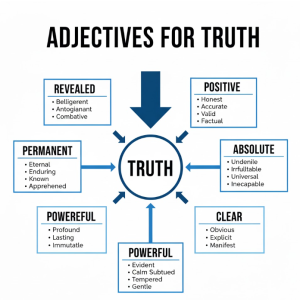
Adjectives for truth are words that modify nouns or pronouns to describe the quality, nature, or degree of truth associated with them. These adjectives help clarify whether something is entirely true, partially true, believed to be true, or intentionally misleading.
They add nuance and precision to our language, allowing us to express the complexities of truth in various contexts.
These adjectives function to provide additional information about the noun they modify, specifically relating to its veracity or correspondence to reality. They can indicate the certainty, objectivity, or reliability of a statement, fact, or belief.
The choice of adjective significantly impacts the meaning conveyed, influencing how the information is perceived and understood.
The context in which these adjectives are used is crucial. For example, the adjective “accurate” might be appropriate when describing a scientific measurement, while “sincere” is better suited for describing someone’s feelings.
Understanding the specific connotations and implications of each adjective is essential for effective communication. These adjectives can also highlight the intent behind a statement, such as whether it is genuinely meant to be truthful or is designed to deceive.
Structural Breakdown
Adjectives for truth, like all adjectives, typically precede the noun they modify (attributive position) or follow a linking verb such as “be,” “seem,” or “appear” (predicative position). The structure is fairly straightforward, but understanding the placement and the verb it modifies is key to understanding the full meaning of the sentence.
Attributive Position: In this structure, the adjective comes directly before the noun. This is the most common placement for adjectives. For example: “the accurate data,” “a genuine account,” or “the verifiable facts.” The adjective directly modifies the noun, providing information about its truthfulness.
Predicative Position: Here, the adjective follows a linking verb. The linking verb connects the subject of the sentence to the adjective, which describes a quality or state of the subject. For example: “The statement is true,” “His intentions seem sincere,” or “The report appears accurate.” The adjective describes the subject via the linking verb.
Adjectives for truth can also be modified by adverbs to further refine their meaning. For instance, “absolutely true,” “relatively accurate,” or “completely false.” These adverbs intensify or qualify the adjective, providing a more precise description of the level of truth.
Types and Categories of Adjectives for Truth
Adjectives describing truth can be categorized based on the aspect of truth they emphasize. These categories help us understand the nuances and contexts in which different adjectives are used.
We can categorize them into adjectives that describe absolute truth, relative truth, subjective truth, approximate truth, and deceptive truth.
Adjectives for Absolute Truth
These adjectives indicate a state of complete and undeniable truth. They suggest that something is true without any qualification or doubt. Examples include: true, accurate, factual, correct, verifiable, valid, authentic, genuine, definitive, and irrefutable. These words are used when there is no room for error or interpretation.
Adjectives for Relative Truth
These adjectives suggest that truth is dependent on context, perspective, or circumstances. They acknowledge that what is true in one situation might not be true in another. Examples include: relatively true, conditionally true, partially true, substantially true, largely true, generally true, arguably true, and true to some extent. These terms highlight the contextual nature of truth.
Adjectives for Subjective Truth
These adjectives describe truth as it is perceived or experienced by an individual. They emphasize personal beliefs, feelings, and interpretations. Examples include: sincere, heartfelt, honest, candid, truthful (in intent), and genuine (in feeling). These words focus on the internal state of the person expressing the truth.
Adjectives for Approximate Truth
These adjectives indicate that something is close to being true but might not be perfectly accurate. They suggest a level of approximation or estimation. Examples include: approximate, estimated, close, near, rough, ballpark, and virtually true. These terms are often used in scientific or mathematical contexts.
Adjectives for Deceptive Truth
These adjectives describe situations where truth is manipulated or misrepresented, either intentionally or unintentionally. They highlight the potential for deception or ambiguity. Examples include: misleading, deceptive, fallacious, spurious, apocryphal, and ostensible. These words are used when questioning the validity or intent behind a statement.
Examples of Adjectives for Truth
The following tables provide examples of how adjectives for truth are used in sentences, categorized by the types discussed above. Each table includes a wide range of examples to illustrate the different contexts and nuances of each adjective.
The table below presents examples of adjectives for absolute truth in various contexts. Note the specific meaning of each adjective and how it contributes to the overall understanding of the sentence.
| Adjective | Example Sentence |
|---|---|
| True | The statement is true according to the official records. |
| Accurate | The scientist presented accurate data in his research paper. |
| Factual | The documentary presented a factual account of the historical events. |
| Correct | The answer to the math problem was correct. |
| Verifiable | The journalist ensured that all his sources were verifiable. |
| Valid | The argument presented in the debate was logically valid. |
| Authentic | The museum displayed an authentic artifact from ancient Rome. |
| Genuine | The antique dealer confirmed that the painting was a genuine masterpiece. |
| Definitive | The study provided a definitive answer to the long-standing question. |
| Irrefutable | The evidence presented was irrefutable, leaving no room for doubt. |
| Absolute | She had absolute proof of his innocence. |
| Undeniable | The evidence was undeniable, leaving no room for argument. |
| Unquestionable | His loyalty was unquestionable throughout his career. |
| Conclusive | The investigation provided conclusive evidence of fraud. |
| Established | The theory is based on established scientific principles. |
| Demonstrable | The benefits of the new policy were demonstrable within months. |
| Certain | We are certain that the information is correct. |
| Incontrovertible | The facts were incontrovertible, making the case clear. |
| Precise | The measurements were precise, ensuring the accuracy of the experiment. |
| Rigorous | The research followed a rigorous methodology. |
| Literal | The literal meaning of the poem was quite different from its implied meaning. |
| Unambiguous | The instructions were unambiguous, leaving no room for confusion. |
| Exact | The detective sought the exact details of the crime. |
The following table offers examples of adjectives for relative truth. These adjectives highlight that truth can vary depending on the situation or perspective.
Consider the context in each sentence to understand the conditional nature of the truth being described.
| Adjective | Example Sentence |
|---|---|
| Relatively true | The statement is relatively true when compared to other exaggerated claims. |
| Conditionally true | The prediction is conditionally true, depending on the weather patterns. |
| Partially true | The story he told was only partially true; he omitted several key details. |
| Substantially true | The report was substantially true, although there were a few minor inaccuracies. |
| Largely true | His account of the events was largely true, but some aspects were exaggerated. |
| Generally true | It is generally true that exercise is beneficial for health. |
| Arguably true | The claim that technology improves lives is arguably true, but it also has drawbacks. |
| True to some extent | Her statement was true to some extent, but it didn’t capture the whole picture. |
| Contextually true | The statement is contextually true, depending on the historical period. |
| Subjectively true | For him, the memory was subjectively true, even if it differed from reality. |
| Qualified | The expert provided a qualified endorsement of the project. |
| Modified | The original plan was modified to reflect the new circumstances. |
| Limited | The study had limited scope, so its conclusions were not universally applicable. |
| Circumstantial | The evidence was circumstantial and did not provide a definitive answer. |
| Provisional | The agreement was provisional, pending further negotiations. |
| Tentative | The findings were tentative and required more research. |
| Contingent | The success of the project was contingent on securing funding. |
| Conditional | The offer was conditional on meeting certain requirements. |
| Restricted | Access to the information was restricted to authorized personnel. |
| Applicable | The rule is applicable only in certain situations. |
| Relevant | The data is relevant to the specific research question. |
The table below illustrates the use of adjectives for subjective truth, which focus on personal beliefs and feelings. These adjectives emphasize the speaker’s sincerity and the genuineness of their emotions.
Observe how these adjectives add a personal dimension to the concept of truth.
| Adjective | Example Sentence |
|---|---|
| Sincere | Her apology was sincere, and everyone could feel her remorse. |
| Heartfelt | He expressed his heartfelt gratitude to all who had supported him. |
| Honest | She gave an honest account of her experiences during the expedition. |
| Candid | The politician gave a candid interview, addressing all the controversial issues. |
| Truthful (in intent) | Even though he was mistaken, his statement was truthful in intent. |
| Genuine (in feeling) | Her concern for the environment was genuine in feeling, driving her activism. |
| Authentic (in expression) | The artist’s authentic expression of emotion resonated with the audience. |
| Earnest | His earnest desire to help others was evident in his volunteer work. |
| Bona fide | The collector confirmed that the artifact was a bona fide relic. |
| Veritable | The event was a veritable success, exceeding all expectations. |
| Personal | She shared her personal truth with the group. |
| Individual | Each person has their own individual truth. |
| Perceived | Their perceived truth may differ from reality. |
| Felt | The felt truth was more powerful than any fact. |
| Intimate | She revealed her most intimate truths in her memoir. |
| Private | Some truths are too private to share. |
| Internal | His internal truth guided his actions. |
| Emotional | The emotional truth was overwhelming. |
| Subjective | The subjective truth varied from person to person. |
| Experiential | The experiential truth was far different than the theoretical. |
The table below provides examples of adjectives for approximate truth. These adjectives are often used in situations where precision is difficult or impossible to achieve, such as estimations or predictions.
Pay attention to the level of accuracy implied by each adjective.
| Adjective | Example Sentence |
|---|---|
| Approximate | The approximate cost of the project is $1 million. |
| Estimated | The estimated population of the city is around 5 million. |
| Close | The close estimate of the rainfall was within 10% of the actual amount. |
| Near | The near exact time of the event was 2:30 PM. |
| Rough | He gave a rough estimate of the number of attendees. |
| Ballpark | The ballpark figure for the budget is around $50,000. |
| Virtually true | The statement is virtually true, with only minor discrepancies. |
| Nearly accurate | The forecast was nearly accurate, missing the mark by only a few degrees. |
| Around | There were around 100 people at the meeting. |
| About | The project will take about three months to complete. |
| In the vicinity of | The error was in the vicinity of 5%. |
| In the neighborhood of | The cost is in the neighborhood of $200. |
| Quasi | The result was quasi true. |
| Seemingly | The data was seemingly true. |
| Superficially | The story was superficially true. |
The table below provides examples of adjectives for deceptive truth. These adjectives describe situations where truth is distorted or misrepresented, either intentionally or unintentionally.
They highlight the potential for misunderstanding or manipulation. Consider the negative connotations associated with these adjectives.
| Adjective | Example Sentence |
|---|---|
| Misleading | The advertisement contained misleading information about the product’s capabilities. |
| Deceptive | His deceptive tactics tricked many investors into losing money. |
| Fallacious | The argument was based on fallacious reasoning and could not be supported. |
| Spurious | The document was proven to be spurious, lacking any authenticity. |
| Apocryphal | The story about the founding of the city is likely apocryphal. |
| Ostensible | The ostensible reason for the meeting was different from the real purpose. |
| Dubious | The claim seemed dubious, and further investigation was needed. |
| Questionable | The politician’s motives were questionable, given his past actions. |
| False | The accusation was false and completely unfounded. |
| Untrue | The rumor was untrue and caused unnecessary panic. |
| Erroneous | The report contained erroneous data, leading to incorrect conclusions. |
| Inaccurate | The map was inaccurate and led the hikers astray. |
| Fictitious | The account was entirely fictitious and based on imagination. |
| Invented | The story was completely invented to impress his friends. |
| Fabricated | The evidence was fabricated to frame the suspect. |
| Counterfeit | The currency was counterfeit and not accepted by vendors. |
| Sham | The election was a sham, with predetermined results. |
| Bogus | The email was bogus and designed to steal personal information. |
| Illusionary | The promise was illusionary and impossible to fulfill. |
| Specious | The argument was specious and designed to mislead. |
| Deceitful | His deceitful nature made him an untrustworthy friend. |
Usage Rules for Adjectives for Truth
Proper usage of adjectives for truth requires careful consideration of context and intended meaning. Here are some guidelines to help you use these adjectives effectively:
- Choose the Right Level of Certainty: Select adjectives that accurately reflect the level of certainty you want to convey. Use “true” or “accurate” for statements that are undeniably correct, and “relatively true” or “partially true” for statements that require qualification.
- Consider Subjectivity: When describing personal beliefs or feelings, use adjectives like “sincere,” “honest,” or “genuine.” These words emphasize the speaker’s internal state and the authenticity of their emotions.
- Avoid Overstating: Be cautious about using adjectives like “irrefutable” or “definitive” unless you are absolutely certain that the statement is beyond dispute. Overstating the truth can undermine your credibility.
- Be Aware of Deception: Use adjectives like “misleading,” “deceptive,” or “fallacious” when you want to highlight the potential for misunderstanding or manipulation. These words carry negative connotations and should be used judiciously.
- Use Adverbs for Precision: Modify adjectives with adverbs to fine-tune your meaning. For example, “absolutely true,” “relatively accurate,” or “completely false.”
Exceptions and Special Cases: Some adjectives can have multiple meanings depending on the context. For example, “genuine” can refer to authenticity (a genuine artifact) or sincerity (a genuine apology). Pay attention to the surrounding words and the overall meaning of the sentence to determine the correct interpretation.
Common Mistakes with Adjectives for Truth
Here are some common mistakes people make when using adjectives for truth, along with corrections:
| Incorrect | Correct | Explanation |
|---|---|---|
| The data is sincerely. | The data is accurate. | “Sincerely” describes a feeling, not objective data. |
| His statement was absolute, but partially. | His statement was partially true. | “Absolute” and “partially” are contradictory. |
| The story was factual in his opinion. | The story was sincere in his opinion. | “Factual” implies objective truth, while “sincere” reflects personal belief. |
| The estimate was definitively, even though it was approximate. | The estimate was approximate. | “Definitively” and “approximate” are contradictory. |
| The advertisement was honestly misleading. | The advertisement was misleading. | “Honestly” and “misleading” are contradictory; misleading is inherently dishonest. |
| The experiment was true. | The experiment was accurate. | Experiments yield accurate or inaccurate results, not true or false. |
| Her apology felt factual. | Her apology felt sincere. | Apologies are assessed for sincerity, not factual accuracy. |
| The rumor was valid, but untrue. | The rumor was untrue. | “Valid” implies truth or soundness, which contradicts “untrue.” |
Practice Exercises
Test your understanding with these practice exercises. Choose the best adjective from the options provided to complete each sentence.
Exercise 1: Choose the best adjective for absolute truth.
| Question | Options | Answer |
|---|---|---|
| The report provided an ______ account of the events. | a) approximate b) factual c) sincere | b) factual |
| The answer to the question was ______. | a) correct b) relative c) misleading | a) correct |
| The scientist presented ______ data in his research. | a) estimated b) accurate c) subjective | b) accurate |
| The museum displayed an ______ artifact from ancient Egypt. | a) genuine b) approximate c) conditional | a) genuine |
| The evidence was ______, leaving no room for doubt. | a) irrefutable b) arguable c) deceptive | a) irrefutable |
| His explanation was ______, leaving no ambiguity. | a) ambiguous b) questionable c) unambiguous | c) unambiguous |
| The study provided a ______ answer to the long-standing issue. | a) definitive b) tentative c) relative | a) definitive |
| The measurement was ______, ensuring the precision of the experiment. | a) approximate b) precise c) rough | b) precise |
| The claim was based on ______ scientific principles. | a) established b) speculative c) tentative | a) established |
| The findings were ______, demonstrating the effectiveness of the treatment. | a) demonstrable b) circumstantial c) questionable | a) demonstrable |
Exercise 2: Choose the best adjective for relative truth.
| Question | Options | Answer |
|---|---|---|
| The statement is ______ true when compared to other exaggerations. | a) relatively b) absolutely c) deceptively | a) relatively |
| The forecast is ______ true, depending on weather conditions. | a) conditionally b) factually c) sincerely | a) conditionally |
| The story was only ______ true; he omitted key details. | a) partially b) completely c) accurately | a) partially |
| His account was ______ true, but some aspects were exaggerated. | a) largely b) falsely c) precisely | a) largely |
| The study had ______ scope, so its conclusions were not universal. | a) limited b) broad c) definitive | a) limited |
| The agreement was ______, pending further negotiations. | a) provisional b) conclusive c) absolute | a) provisional |
| The success of the project was ______ on securing funding. | a) contingent b) certain c) independent | a) contingent |
| The offer was ______ on meeting specific criteria. | a) conditional b) guaranteed c) unconditional | a) conditional |
| The rule is ______ only in certain circumstances. | a) applicable b) irrelevant c) universal | a) applicable |
| The findings were ______ and required further research. | a) tentative b) conclusive c) definite | a) tentative |
Exercise 3: Choose the best adjective for subjective truth.
| Question | Options | Answer |
|---|---|---|
| Her apology was ______, and everyone felt her remorse. | a) sincere b) approximate c) misleading | a) sincere |
| He expressed his ______ gratitude to all his supporters. | a) heartfelt b) estimated c) fallacious | a) heartfelt |
| She gave an ______ account of her experiences during the journey. | a) honest b) approximate c) deceptive | a) honest |
| The artist’s ______ expression resonated with the audience. | a) authentic b) estimated c) questionable | a) authentic |
| His ______ desire to help others was evident in his actions. | a) earnest b) rough c) spurious | a) earnest |
| She shared her ______ truth with the group during the therapy session. | a) personal b) general c) verifiable | a) personal |
| Each person has their own ______ truth, shaped by their experiences. | a) individual b) collective c) factual | a) individual |
| Their ______ truth may differ significantly from objective reality. | a) perceived b) proven c) demonstrable | a) perceived |
| The ______ truth was more powerful than any documented fact. | a) felt b) fabricated c) estimated | a) felt |
| She revealed her most ______ truths in her intimate memoir. | a) intimate b) public c) superficial | a) intimate |
Exercise 4: Choose the best adjective for approximate truth.
| Question | Options | Answer |
|---|---|---|
| The ______ cost of the project is estimated at $1 million. | a) approximate b) factual c) sincere | a) approximate |
| The ______ population of the city is around 5 million. | a) estimated b) correct c) relative | a) estimated |
| He gave a ______ estimate of the number of attendees. | a) rough b) precise c) subjective | a) rough |
| The ______ figure for the budget is about $50,000. | a) ballpark b) approximate c) conditional | a) ballpark |
| The statement is ______ true, with only minor discrepancies. | a) virtually b) arguable c) deceptive | a) virtually |
| The error was in the ______ of 5%. | a) vicinity b) certainty c) exactness | a) vicinity |
| There were ______ 200 guests at the wedding. | a) around b) exactly c) precisely | a) around |
| The project will take ______ six months to complete. | a) about b) definitely c) accurately | a) about |
| The numbers were ______ true. | a) seemingly b) definitely c) actually | a) seemingly |
| The data was ______ correct. | a) quasi b) established c) demonstrable | a) quasi |
Exercise 5: Choose the best adjective for deceptive truth.
| Question | Options | Answer |
|---|---|---|
| The advertisement contained ______ information about the product. | a) misleading b) factual c) sincere | a) misleading |
| His ______ tactics tricked many investors into losing money. | a) deceptive b) correct c) relative | a) deceptive |
| The argument was based on ______ reasoning. | a) fallacious b) accurate c) subjective | a) fallacious |
| The document was proven to be ______. | a) spurious b) approximate c) conditional | a) spurious |
| The story about the founding of the city is likely ______. | a) apocryphal b) arguable c) deceptive | a) apocryphal |
| The account was entirely ______. | a) fictitious b) factual c) genuine | a) fictitious |
| The evidence was ______ to frame the suspect. | a) fabricated b) verified c) validated | a) fabricated |
| The currency was ______ and not accepted by vendors. | a) counterfeit b) precise c) rough | a) counterfeit |
| The election was a ______, with predetermined results. | a) sham b) honest c) democratic | a) sham |
| The promise was ______, impossible to fulfill. | a) illusionary b) sincere c) factual | a) illusionary |
Advanced Topics
For those looking to delve deeper, here are some advanced topics related to adjectives for truth:
- Philosophical Implications: Explore how different philosophical viewpoints influence the use of adjectives for truth. Consider the perspectives of realism, relativism, and subjectivism.
- Legal Contexts: Examine how adjectives for truth are used in legal documents and court proceedings. Understand the importance of precision and accuracy in legal language.
- Scientific Communication: Analyze how scientists use adjectives for truth to convey the reliability and validity of research findings. Consider the role of peer review and replication in establishing scientific truth.
- Political Discourse: Investigate how politicians and media outlets use adjectives for truth to shape public opinion. Be aware of the potential for manipulation and bias in political communication.
- Literary Analysis: Study how authors use adjectives for truth to create nuanced and complex characters and narratives. Consider the role of truth and deception in storytelling.
Frequently Asked Questions
What is the difference between “true” and “accurate”?
While both “true” and “accurate” indicate correctness, “true” generally refers to a statement that aligns with reality or fact, whereas “accurate” implies a higher degree of precision and exactness. For example, a general statement might be “true,” but a scientific measurement needs to be “accurate.”
When should I use “sincere” instead of “honest”?
“Sincere” refers to the genuineness of feelings or intentions, while “honest” refers to the truthfulness of words or actions. Use “sincere” when describing someone’s emotional state and “honest” when describing their behavior or communication.
How can I avoid being misleading when using adjectives for truth?
To avoid being misleading, always consider the context and be as precise as possible. Avoid overstating the truth, and use qualifiers when necessary.
If there is any doubt about the accuracy of a statement, acknowledge it.
Are there any adjectives that are always subjective?
Yes, adjectives like “sincere,” “heartfelt,” and “personal” are inherently subjective because they describe individual feelings and beliefs. Their truth depends on the perspective of the person experiencing them.
How do I choose the right adjective for truth in a formal essay?
In a formal essay, clarity and precision are crucial. Choose adjectives that are specific and well-defined, and avoid colloquial or ambiguous language.
Back up your claims with evidence and use adjectives that reflect the strength of that evidence.
Conclusion
Mastering adjectives for truth is essential for clear and effective communication. By understanding the nuances of these words and using them appropriately, you can express your thoughts and ideas with greater precision and impact.
This guide has provided you with a comprehensive overview of adjectives for truth, including definitions, examples, usage rules, and common mistakes. Continue to practice and refine your skills, and you will become a more confident and articulate communicator.