

Choosing the right words to describe an enemy can significantly impact the tone and meaning of your writing. Whether you’re crafting a fictional narrative, analyzing historical events, or engaging in a debate, the adjectives you select paint a vivid picture of the opposition.
This article explores a wide range of adjectives suitable for describing enemies, delving into their nuances, connotations, and appropriate contexts. Understanding these words will empower you to express your ideas with greater precision and impact.
This comprehensive guide is designed for English language learners, writers, students, and anyone seeking to expand their vocabulary and improve their descriptive writing skills. By examining various types of adjectives and their applications, you’ll gain a deeper understanding of how language shapes our perception of conflict and opposition.
Table of Contents
- Introduction
- Definition of Adjectives for “Enemy”
- Structural Breakdown
- Types and Categories of Adjectives for “Enemy”
- Examples of Adjectives for “Enemy”
- Usage Rules
- Common Mistakes
- Practice Exercises
- Advanced Topics
- FAQ
- Conclusion
Definition of Adjectives for “Enemy”
An adjective is a word that modifies a noun or pronoun, providing more information about its qualities, characteristics, or attributes. When used to describe an “enemy,” adjectives help to paint a more vivid and nuanced picture of the person or group considered an adversary. These descriptive words can convey the enemy’s nature, behavior, intentions, and impact.
Adjectives for “enemy” can be classified based on the specific aspect they highlight. For example, some adjectives emphasize the enemy’s hostility (e.g., belligerent, antagonistic), while others focus on their cunning (e.g., treacherous, insidious). The choice of adjective depends on the specific context and the desired effect. Furthermore, adjectives can carry strong connotations, influencing the reader’s perception of the enemy.
The function of these adjectives is twofold: to provide descriptive detail and to evoke emotional responses. By carefully selecting adjectives, writers can shape the reader’s understanding of the conflict and the characters involved.
The context in which these adjectives are used is crucial. The same adjective can carry different weight depending on the surrounding words and the overall tone of the piece.
Structural Breakdown
Adjectives typically precede the noun they modify (attributive position), but they can also follow a linking verb such as “is,” “are,” “was,” or “were” (predicative position). For instance:
- Attributive: “The vicious enemy attacked at dawn.”
- Predicative: “The enemy was vicious.”
Adjectives can also be modified by adverbs to further refine their meaning. For example:
- “The extremely ruthless enemy showed no mercy.”
Additionally, adjectives can be part of adjective phrases, which include the adjective and any modifiers or complements. These phrases provide more detailed descriptions.
- “An enemy determined to win at all costs posed a significant threat.”
Understanding these structural elements allows for more precise and effective use of adjectives in describing enemies.
Types and Categories of Adjectives for “Enemy”
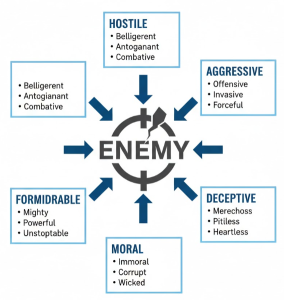
Adjectives used to describe enemies can be categorized based on the specific characteristics or qualities they emphasize. Here are some key categories:
Hostile Adjectives
These adjectives emphasize the enemy’s antagonistic and aggressive nature. They highlight the enemy’s desire to cause harm or conflict.
Aggressive Adjectives
These adjectives focus on the enemy’s proactive and forceful approach. They suggest a willingness to initiate conflict and use force.
Deceptive Adjectives
These adjectives highlight the enemy’s use of trickery and deceit. They suggest a lack of honesty and a willingness to manipulate others.
Ruthless Adjectives
These adjectives emphasize the enemy’s lack of compassion or empathy. They suggest a willingness to inflict harm without remorse.
Formidable Adjectives
These adjectives highlight the enemy’s strength and power. They suggest a significant challenge or threat.
Moral Adjectives
These adjectives describe the enemy’s ethical or moral standing. They suggest a deviation from accepted principles of right and wrong.
Examples of Adjectives for “Enemy”
The following tables provide examples of adjectives for “enemy” categorized by type, along with example sentences to illustrate their usage.
Hostile Adjective Examples
This table showcases adjectives that emphasize the enemy’s antagonistic and aggressive nature. Each example is paired with a sentence to illustrate its usage.
| Adjective | Example Sentence |
|---|---|
| Belligerent | The belligerent enemy nation threatened to invade its neighbor. |
| Antagonistic | His antagonistic attitude made it difficult to negotiate a peaceful resolution with the enemy. |
| Combative | The combative enemy forces engaged in fierce battles along the border. |
| Rival | The two companies were rival enemies in the tech industry, constantly vying for market share. |
| Adversarial | The adversarial relationship between the two political parties hindered progress on key issues. |
| Opposing | The opposing forces clashed on the battlefield. |
| Agressive | The agressive enemy continued to advance into our territory. |
| Contentious | The contentious enemy made peace negotiations difficult. |
| Inimical | The inimical forces sought to undermine our efforts. |
| Alien | The alien enemy was unlike anything we had faced before. |
| Conflicting | The conflicting aims of the enemies made compromise impossible. |
| Oppugnant | The oppugnant enemy sought to destroy our way of life. |
| Repugnant | The repugnant enemy inspired disgust and hatred. |
| Resistant | The resistant enemy refused to surrender. |
| Defiant | The defiant enemy stood their ground despite heavy losses. |
| Quarrelsome | The quarrelsome enemy constantly provoked conflict. |
| Warlike | The warlike enemy was always prepared for battle. |
| Truculent | The truculent enemy was eager to fight. |
| Pugnacious | The pugnacious enemy was always looking for a fight. |
| Militant | The militant enemy was committed to armed conflict. |
| Fiery | The fiery enemy launched a devastating attack. |
| Fierce | The fierce enemy fought with unmatched intensity. |
| Wrathful | The wrathful enemy sought revenge for past defeats. |
Aggressive Adjective Examples
This table provides adjectives that highlight the enemy’s proactive and forceful approach. Each adjective is used in a sentence for context.
| Adjective | Example Sentence |
|---|---|
| Offensive | The offensive enemy launched a surprise attack. |
| Invasive | The invasive enemy forces occupied several key cities. |
| Assaulting | The assaulting enemy troops stormed the fortress. |
| Attacking | The attacking enemy planes bombed the city. |
| Raiding | The raiding enemy ships plundered coastal villages. |
| Pushy | The pushy enemy demanded more territory. |
| Overbearing | The overbearing enemy imposed strict rules on the conquered people. |
| Intrusive | The intrusive enemy spies gathered sensitive information. |
| Forceful | The forceful enemy made significant gains on the battlefield. |
| Imposing | The imposing enemy army instilled fear in the hearts of the defenders. |
| Predatory | The predatory enemy exploited our weaknesses. |
| Dominating | The dominating enemy sought to control the entire region. |
| Imperialistic | The imperialistic enemy aimed to expand its empire. |
| Expansionist | The expansionist enemy annexed neighboring territories. |
| Encroaching | The encroaching enemy gradually seized our land. |
| Violent | The violent enemy committed atrocities against civilians. |
| Brutal | The brutal enemy showed no mercy. |
| Savage | The savage enemy left a trail of destruction. |
| Ferocious | The ferocious enemy fought with unmatched intensity. |
| Vigorous | The vigorous enemy launched a relentless offensive. |
| Mighty | The mighty enemy seemed unstoppable. |
| Powerfull | The powerfull enemy was a force to be reckoned with. |
| Commanding | The commanding enemy general led his troops to victory. |
Deceptive Adjective Examples
This table lists adjectives that highlight the enemy’s use of trickery and deceit. Examples are provided to show how each adjective can be used.
| Adjective | Example Sentence |
|---|---|
| Treacherous | The treacherous enemy betrayed our trust. |
| Deceitful | The deceitful enemy spread false rumors to undermine our morale. |
| Insidious | The insidious enemy infiltrated our ranks with spies. |
| Cunning | The cunning enemy devised elaborate traps. |
| Wily | The wily enemy outsmarted our generals with clever tactics. |
| Sly | The sly enemy negotiated a false truce. |
| Artful | The artful enemy manipulated the media to gain public support. |
| Crafty | The crafty enemy used disguises to infiltrate our base. |
| Scheming | The scheming enemy plotted our downfall in secret. |
| Underhanded | The underhanded enemy resorted to dirty tricks. |
| Duplicitous | The duplicitous enemy pretended to be our ally. |
| Fraudulent | The fraudulent enemy used fake documents to deceive us. |
| Perfidious | The perfidious enemy broke their promises. |
| Guileful | The guileful enemy used charm to manipulate us. |
| Chicanerous | The chicanerous enemy used legal loopholes to their advantage. |
| Evasive | The evasive enemy avoided direct confrontation. |
| Misleading | The misleading enemy spread propaganda. |
| Fallacious | The fallacious enemy presented false arguments. |
| Untruthful | The untruthful enemy lied about their intentions. |
| Disingenuous | The disingenuous enemy feigned ignorance. |
| Conniving | The conniving enemy always had a hidden agenda. |
| Machiavellian | The Machiavellian enemy believed the ends justified the means. |
| Subtle | The subtle enemy worked in the shadows. |
Ruthless Adjective Examples
This table showcases adjectives that emphasize the enemy’s lack of compassion or empathy. Example sentences are included for each adjective.
| Adjective | Example Sentence |
|---|---|
| Merciless | The merciless enemy showed no compassion to the prisoners. |
| Unrelenting | The unrelenting enemy pressed forward despite heavy casualties. |
| Pitiless | The pitiless enemy executed all who opposed them. |
| Heartless | The heartless enemy destroyed the orphanage. |
| Inhuman | The inhuman enemy treated their captives like animals. |
| Callous | The callous enemy ignored the suffering of the refugees. |
| Cruel | The cruel enemy inflicted torture upon their victims. |
| Brutal | The brutal enemy committed unspeakable atrocities. |
| Savage | The savage enemy ravaged the countryside. |
| Vicious | The vicious enemy attacked without warning. |
| Barbaric | The barbaric enemy destroyed historical artifacts. |
| Remorseless | The remorseless enemy felt no guilt for their actions. |
| Implacable | The implacable enemy refused to negotiate. |
| Unforgiving | The unforgiving enemy sought revenge for every slight. |
| Relentless | The relentless enemy pursued us to the ends of the earth. |
| Severe | The severe enemy imposed harsh penalties. |
| Austere | The austere enemy demanded strict obedience. |
| Grim | The grim enemy showed no emotion. |
| Stern | The stern enemy enforced rigid discipline. |
| Harsh | The harsh enemy treated their subjects cruelly. |
| Ruthless | The ruthless enemy crushed all resistance. |
| Cold-blooded | The cold-blooded enemy planned their attacks meticulously. |
| Unsparing | The unsparing enemy inflicted maximum damage. |
Formidable Adjective Examples
This table provides adjectives that highlight the enemy’s strength and power. Each adjective is presented with an example sentence.
| Adjective | Example Sentence |
|---|---|
| Powerful | The powerful enemy nation possessed advanced weaponry. |
| Strong | The strong enemy army was well-trained and equipped. |
| Mighty | The mighty enemy empire controlled vast territories. |
| Dominant | The dominant enemy faction controlled the government. |
| Imposing | The imposing enemy fortress was heavily fortified. |
| Daunting | The daunting enemy fleet blocked our supply lines. |
| Intimidating | The intimidating enemy soldiers wore fearsome masks. |
| Redoubtable | The redoubtable enemy general had a reputation for invincibility. |
| Invincible | The invincible enemy seemed impossible to defeat. |
| Unstoppable | The unstoppable enemy advanced relentlessly. |
| Formidable | The formidable enemy posed a significant threat. |
| Potent | The potent enemy possessed a secret weapon. |
| Valiant | The valiant enemy fought with courage and determination. |
| Resilient | The resilient enemy recovered quickly from setbacks. |
| Tenacious | The tenacious enemy refused to give up. |
| Unyielding | The unyielding enemy stood firm against our attacks. |
| Determined | The determined enemy was resolved to conquer us. |
| Relentless | The relentless enemy pursued us without pause. |
| Persistent | The persistent enemy kept attacking despite heavy losses. |
| Aggressive | The aggressive enemy launched a surprise offensive. |
| Widespread | The widespread enemy influence corrupted the government. |
| Deep-rooted | The deep-rooted enemy hatred fueled the conflict. |
| Entrenched | The entrenched enemy was difficult to dislodge. |
Moral Adjective Examples
This table provides adjectives that describe the enemy’s ethical or moral standing. Each adjective is used in a sentence for context.
| Adjective | Example Sentence |
|---|---|
| Evil | The evil enemy sought to destroy all that was good. |
| Wicked | The wicked enemy reveled in the suffering of others. |
| Immoral | The immoral enemy disregarded all ethical principles. |
| Unethical | The unethical enemy used dishonest tactics. |
| Corrupt | The corrupt enemy leaders enriched themselves at the expense of their people. |
| Depraved | The depraved enemy engaged in unspeakable acts. |
| Perverse | The perverse enemy found pleasure in cruelty. |
| Sinister | The sinister enemy plotted in the shadows. |
| Malicious | The malicious enemy spread hateful propaganda. |
| Vile | The vile enemy committed heinous crimes. |
| Base | The base enemy acted out of selfish motives. |
| Ignoble | The ignoble enemy betrayed their allies. |
| Dishonorable | The dishonorable enemy broke their treaties. |
| Treacherous | The treacherous enemy ambushed our troops. |
| Degenerate | The degenerate enemy society was morally bankrupt. |
| Iniquitous | The iniquitous enemy committed grave injustices. |
| Nefarious | The nefarious enemy engaged in secret conspiracies. |
| Atrocious | The atrocious enemy committed terrible war crimes. |
| Heinous | The heinous enemy actions shocked the world. |
| Abominable | The abominable enemy practices were universally condemned. |
| Despicable | The despicable enemy was held in contempt by all. |
| Contemptible | The contemptible enemy was unworthy of respect. |
| Loathsome | The loathsome enemy inspired disgust and revulsion. |
Usage Rules
When using adjectives to describe enemies, consider the following rules:
- Placement: Adjectives typically precede the noun they modify (e.g., “the fierce enemy”). However, they can also follow linking verbs (e.g., “The enemy was fierce“).
- Order: When using multiple adjectives, follow the general order: opinion, size, age, shape, color, origin, material, purpose (e.g., “the vicious, large, ancient enemy”).
- Context: Choose adjectives that accurately reflect the enemy’s characteristics and the overall tone of your writing.
- Connotation: Be aware of the connotations associated with different adjectives. Some adjectives may carry stronger emotional weight than others.
- Avoid redundancy: Do not use multiple adjectives that convey the same meaning (e.g., avoid saying “the cruel, merciless enemy” when “the merciless enemy” suffices).
Common Mistakes
Here are some common mistakes to avoid when using adjectives to describe enemies:
- Misusing adjectives with similar meanings: Confusing adjectives like “belligerent” and “aggressive.” “Belligerent” implies a general hostility, while “aggressive” suggests a proactive and forceful approach.
- Incorrect adjective order: Failing to follow the standard order of adjectives when using multiple adjectives.
- Using overly strong adjectives inappropriately: Using adjectives like “evil” or “atrocious” when a milder term would be more accurate.
- Redundancy: Using multiple adjectives that convey the same meaning.
Here are some examples of common mistakes and their corrections:
| Incorrect | Correct | Explanation |
|---|---|---|
| The cruel, merciless, heartless enemy. | The merciless enemy. | Avoid redundancy by using a single, strong adjective. |
| The size opinion enemy. | The opinion size enemy. | Adjectives should follow standard order. |
| The belligerent aggressive enemy. | The aggressive enemy. | Choose the adjective that best fits the context. |
Practice Exercises
Test your understanding of adjectives for “enemy” with the following exercises.
Exercise 1: Identifying Adjectives
Identify the adjectives used to describe the enemy in each sentence.
| Question | Answer |
|---|---|
| 1. The treacherous enemy ambushed our troops. | treacherous |
| 2. The formidable enemy posed a significant threat. | formidable |
| 3. The enemy was ruthless and showed no mercy. | ruthless |
| 4. The belligerent enemy nation threatened war. | belligerent |
| 5. The cunning enemy devised a clever plan. | cunning |
| 6. The aggressive enemy advanced rapidly. | aggressive |
| 7. The deceitful enemy spread false information. | deceitful |
| 8. The powerful enemy controlled the region. | powerful |
| 9. The immoral enemy disregarded all ethical principles. | immoral |
| 10. The enemy was savage and brutal. | savage |
Exercise 2: Choosing the Right Adjective
Choose the best adjective from the options provided to describe the enemy in each sentence.
| Question | Options | Answer |
|---|---|---|
| 1. The ______ enemy used trickery to win. | (a) strong (b) cunning (c) powerful | (b) cunning |
| 2. The ______ enemy showed no compassion. | (a) ruthless (b) formidable (c) aggressive | (a) ruthless |
| 3. The ______ enemy was always ready to fight. | (a) deceitful (b) belligerent (c) insidious | (b) belligerent |
| 4. The ______ enemy controlled vast resources. | (a) evil (b) strong (c) treacherous | (b) strong |
| 5. The ______ enemy acted without morals. | (a) moral (b) immoral (c) amoral | (b) immoral |
| 6. The ______ enemy launched a surprise attack. | (a) relentless (b) aggressive (c) insidious | (b) aggressive |
| 7. The ______ enemy spread lies and rumors. | (a) formidable (b) deceitful (c) brutal | (b) deceitful |
| 8. The ______ enemy was a force to be reckoned with. | (a) powerful (b) cunning (c) ruthless | (a) powerful |
| 9. The ______ enemy was motivated by evil intentions. | (a) aggressive (b) evil (c) formidable | (b) evil |
| 10. The ______ enemy left a trail of destruction and chaos. | (a) savage (b) cunning (c) powerful | (a) savage |
Exercise 3: Sentence Completion
Complete each sentence with an appropriate adjective to describe the enemy.
| Question | Answer |
|---|---|
| 1. The ______ enemy plotted our downfall in secret. | scheming |
| 2. The ______ enemy refused to surrender. | defiant |
| 3. The ______ enemy was difficult to defeat. | formidable |
| 4. The ______ enemy showed no regard for human life. | inhuman |
| 5. The ______ enemy betrayed our trust. | treacherous |
| 6. The ______ enemy advanced steadily into our lands. | aggressive |
| 7. The ______ enemy used propaganda to mislead the public. | deceitful |
| 8. The ______ enemy controlled the seas with their warships. | powerful |
| 9. The ______ enemy committed terrible atrocities against civilians. | evil |
| 10. The ______ enemy destroyed homes and left many homeless. | savage |
Advanced Topics
For advanced learners, consider exploring the following topics:
- Figurative language: How metaphors, similes, and personification can be used to describe enemies in creative and impactful ways.
- Historical context: How the choice of adjectives to describe enemies can reflect historical biases and prejudices.
- Literary analysis: Analyzing how authors use adjectives to create complex and nuanced portrayals of enemies in literature.
- Political discourse: Examining how politicians and media outlets use adjectives to shape public opinion about adversaries.
Delving deeper into these areas will provide a more sophisticated understanding of the power and impact of language in shaping our perception of enemies.
FAQ
- What is the difference between “belligerent” and “aggressive”?While both terms describe hostile behavior, “belligerent” implies a general readiness to fight or argue, whereas “aggressive” suggests a proactive and forceful approach, often initiating conflict. A belligerent nation might make threatening statements, while an aggressive nation might launch an invasion.
- How do I choose the right adjective to describe an enemy?Consider the specific characteristics and actions of the enemy. Are they deceitful? Ruthless? Powerful? Choose an adjective that accurately reflects their nature and the overall tone of your writing. It’s also crucial to understand the connotations associated with each word to ensure the desired impact.
- Is it okay to use multiple adjectives to describe an enemy?Yes, but use them sparingly and avoid redundancy. Choose adjectives that
accurately enhance the description without sounding repetitive or overwrought. A carefully chosen pair of adjectives can be more effective than a long string of similar words.
Conclusion
Selecting the right adjectives to describe an enemy is a crucial skill for effective communication and impactful writing. By understanding the nuances, connotations, and usage rules of various adjectives, you can paint a vivid and accurate picture of the opposition.
Whether you’re crafting a fictional narrative, analyzing historical events, or engaging in a debate, the careful choice of words can significantly enhance your message and shape your audience’s perception.
This comprehensive guide has provided a wide range of adjectives suitable for describing enemies, along with examples, exercises, and advanced topics for further exploration. By mastering these concepts, you can express your ideas with greater precision, clarity, and impact, making your writing more compelling and persuasive.